

Wingspan Bird Powers Explained: Brown, White, and Pink
This guide explains how the power colors work. For which specific birds are worth playing, see our bird card tier list — the Power 4 and the full tiers.
The first few games of Wingspan, most people treat bird powers like bonus text — something nice to have, not something to build around. Then they play against someone who understands the power system, and they watch that person quietly generate food, cards, and eggs seemingly out of nowhere.
Some links below are Amazon affiliate links — as an Amazon Associate, King Panda Games earns from qualifying purchases at no extra cost to you. Full disclosure.
Understanding what each power color does — and when it fires — is the single biggest mechanical unlock in Wingspan. Everything else flows from this.
If you’re new to Wingspan entirely, start with our full Wingspan review before diving into power mechanics.
Brown Powers: The Engine’s Core
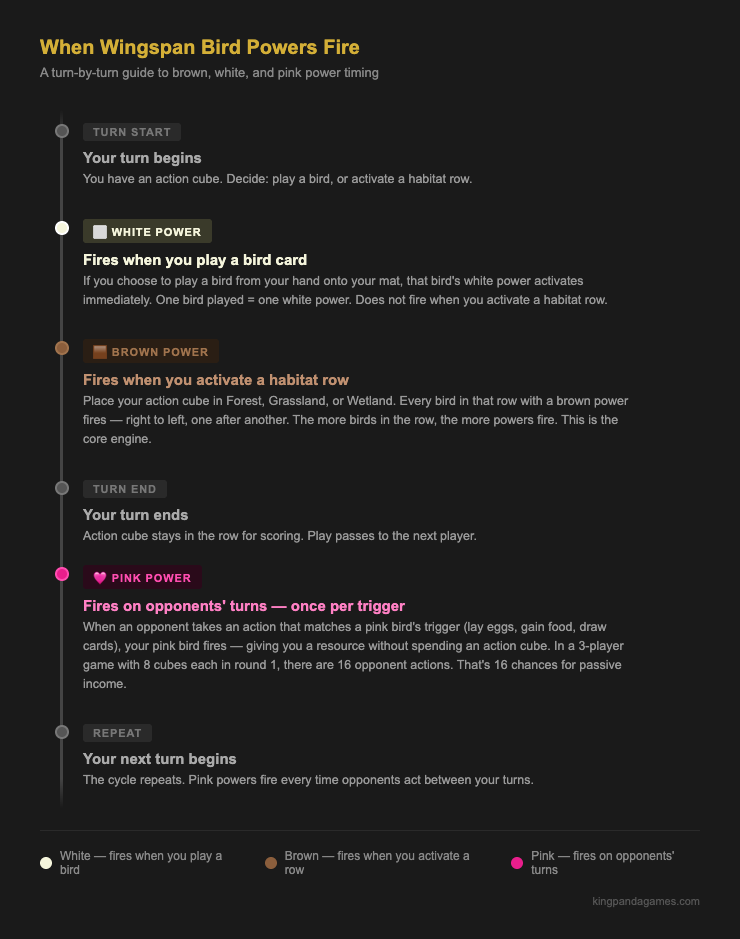
Brown powers are the foundation of any Wingspan engine. They activate when you place an action cube in that bird’s habitat row — firing from right to left, through every bird in the row, every time you take that habitat action.
The key phrase: every time. Not just when you play the bird. Every time you place an action cube in Forest, Grassland, or Wetland, every brown-power bird in that row activates in sequence.
This is why chaining birds in a single habitat matters so much. A Forest row with five brown-power birds doesn’t just gain you 1 food — it gains food, caches food, draws a card, tucks a card, and gains more food. One action cube. All five powers fire.
Brown powers come in several subtypes:
- Gain resources: food, eggs, cards — the basic economy of the game
- Cache food: places food tokens on the bird permanently (1 point each at game end)
- Tuck cards: slides a card under the bird for end-game points (1 point each)
- Repeat: activates another bird’s brown power a second time on the same turn
- Copy: takes on another bird’s power for the current activation
Repeat and copy birds are the multipliers of your engine. A Repeat bird in a Grassland row that doubles your Robin’s egg-laying power effectively doubles your eggs-per-action every time you lay eggs. Once you understand what Repeat does, you’ll start actively seeking these birds in the late draw rather than treating them as situational.
The rule: evaluate every bird you might play by asking “which other birds in my row does this chain with?” A brown power that chains with three existing birds is more valuable than a standalone power, even if the standalone power looks bigger in isolation.
White Powers: The Underrated Activators
White powers are once-per-turn activators that trigger when you play a bird card — specifically in the moment of placing the bird on your mat.
Most players underestimate white powers in the early game because they only fire when you’re spending resources to play a bird, which feels expensive. By mid-game, when you’re playing a bird every 2–3 turns, white powers become reliable secondary income that don’t cost you any additional action cubes.
Common white powers:
– Draw cards when you play a bird in a specific habitat
– Gain food tokens when you play a bird that eats a specific food type
– Lay eggs on birds already on your mat
– Look at the top card of the deck and decide whether to take it
The most undervalued white powers are the ones that gain you resources from the birdfeeder or the egg supply when you play a bird. These effectively reduce the net cost of playing expensive birds — you pay 3 wheat to place a bird, but the white power gives you 2 food back, making the real cost 1 wheat.
White powers are best in the first two rounds when you’re placing several birds quickly. In rounds 3 and 4, when you’re often taking only 5 total actions, white powers fire less frequently — but when they do, they matter.
It’s round 1. You play a Pelican in your Wetland row. Its white power fires: draw 2 cards from the top of the deck and keep 1. You now have more options for your next bird play than you paid for. The Pelican cost you 1 fish to play — but it effectively paid for itself in card draw. That’s white power value: not spectacular, but consistently reducing the friction of playing birds.
Pink Powers: Passive Income That Wins Games
Pink powers are the most powerful power type in Wingspan — and the most misunderstood.
A pink power activates once between turns, triggered by a specific opponent action. Not on your turn. Not when you spend an action cube. On your opponents’ turns, automatically, when the trigger condition is met.
The common triggers:
– When any player lays eggs (the most common trigger)
– When any player gains food from the birdfeeder
– When any player draws bird cards
– When the player to your left takes a specific action
Here’s what makes this remarkable: in a 3-player game with 8 action cubes each in round 1, there are 16 opponent turns happening around you before your action cubes run out. Every one of those turns is a potential pink power trigger. A player with three pink-power birds running is generating resources on every single one of those turns — without spending a single action cube.
What most players understand about pink powers: “I get something when my opponent does something.” A free bonus — nice, but secondary to what happens on your own turn.
What experienced players understand about pink powers: Pink powers are a parallel economy running alongside your main turns. By round 3, a player with strong pink birds has generated 6–10 additional resources purely from opponents’ actions. That’s 6–10 resources they didn’t spend action cubes to earn — and action cubes are the scarcest resource in the game.
The most important pink powers to look for:
Triggered by egg-laying (most common): Any player laying eggs fires this. Since egg-laying is one of the two or three most common actions in the game, these triggers fire constantly — especially in rounds 2 and 3 when players are building their engines and laying frequently.
Triggered by food-gathering: Also frequent, especially early game. These trigger on the most common round-1 action and provide resources that help you play birds in round 2.
Triggered by card-drawing: Less common but high-value when they fire, since card-drawing birds tend to cluster in late-game strategies.
How to Build a Power-Diverse Engine
The strongest engines combine all three power types working together:
White powers fire when you’re building — they give you the resources to play more birds, making early bird placement cheaper and faster. Brown powers fire as you activate — they multiply every action you take. Pink powers fire between turns — they generate background income that compounds quietly over four rounds.
- Round 1–2: Prioritize white-power birds that cheapen your early placements and at least one pink-power bird that triggers on common actions (egg-laying, food-gathering).
- Round 2–3: Fill your primary habitat with brown-power birds that chain together. A 4-bird Grassland chain generating 5+ eggs per activation is the heart of most winning engines.
- Rounds 3–4: Add pink-power birds that compound your passive income as opponents ramp up their own actions.
The mistake most players make is building purely for brown powers — filling rows with birds that chain, but leaving no pink capacity. Their engine runs beautifully on their turns and generates almost nothing between turns. The player with two pink-power birds and a slightly less impressive chain usually has more resources by round 4.
Worth knowing: The “repeat” and “copy” distinction matters more than most players realize. Repeat fires the same power twice — predictable and stackable. Copy borrows another bird’s power for the current turn — flexible but dependent on your mat state. Repeat birds are generally safer investments early; copy birds become stronger as your mat fills with high-value brown powers worth copying.
Want more birds with new power types to build around? our Wingspan expansions ranking covers which one to buy first, and the short answer is Oceania — 95 more birds, plus nectar, a wild food you can spend as any type.
Check Wingspan: Oceania price on Amazon →
Frequently Asked Questions
What is the difference between brown, white, and pink powers in Wingspan?
Brown powers activate when you place an action cube in that bird’s habitat row — they fire as part of your turn. White powers activate once when you play a bird card. Pink powers are passive: they trigger once between turns, when opponents take specific actions like laying eggs or gaining food. Pink powers generate resources without costing you any action cubes.
Which bird power color is best in Wingspan?
Pink powers have the highest ceiling because they generate resources between your turns without spending action cubes. However, the best engine combines all three: white powers to reduce the cost of early bird placement, brown powers to chain resources when you activate a habitat, and pink powers to accumulate resources passively. Relying on only one color leaves your engine with gaps.
How do repeat and copy powers work in Wingspan?
Repeat causes a bird to activate its brown power a second time during your turn. Copy gives a bird the ability of another bird on your mat for that activation. Repeat powers are usually more reliable because they’re predictable — you know exactly what will happen. Copy powers are powerful but depend on which other birds you’ve already played.
Do pink powers trigger during the Automa’s turn in solo Wingspan?
No — pink powers do not trigger during the Automa’s turn in solo Wingspan. This is a commonly misplayed rule. Pink powers only trigger when a human opponent takes actions, so solo Wingspan naturally produces less between-turn income than multiplayer. This is intentional — the Automa is designed to be competitive on goals rather than through resource generation.
What does “tuck a card” mean in Wingspan?
Tucking means placing a bird card from your hand or from the tray face-down under a bird already on your mat. Tucked cards count as 1 point each at the end of the game. Some birds have brown or pink powers that automatically tuck cards as part of their activation. Tucking is one of the strongest end-game scoring strategies when paired with a bonus card that rewards tucked cards.
What does “cache food” mean in Wingspan?
Caching means placing a food token directly on a bird card on your mat, where it will stay until end game and count as 1 point. Cached food cannot be spent as regular food — it’s locked in for points once placed. Caching is most valuable when combined with pink powers that automatically cache food between your turns, generating points without costing you any actions.