

The box says 2–8+ players. Every count in that range is technically legal. But if you’ve played Codenames at different sizes, you know the experience varies significantly — and some player counts that are “supported” feel like a punishment.
Some links below are Amazon affiliate links — as an Amazon Associate, King Panda Games earns from qualifying purchases at no extra cost to you. Full disclosure.
Here’s the honest breakdown.
Six Players Is the Answer
The best Codenames session is six people: two teams of three. At this count, both Spymasters are working under real pressure, and both teams have enough operatives to generate genuine disagreement before each guess.
That disagreement is the key. Codenames is at its best when your team debates a guess before making it — when someone argues for COLD and someone else argues for ICE and the team has to commit. With three operatives per team, that debate happens organically. Someone always has a different read, and working through it together is where the fun actually lives.
The competitive dynamic also matters. Two Spymasters across the table from each other — watching the same board, knowing different things — creates a metagame within the game. The Spymaster with a 4-card clue locked in will sometimes give it just to put pressure on the other side.
Four Players: Still Good, Noticeably Different
At four players (2v2), Codenames works but loses something specific: team deliberation. With one operative per team, there’s no one to argue with. You give a clue, your single partner guesses, the turn ends. You miss the back-and-forth that makes six-player Codenames feel social.
It plays faster — rounds are tighter, turns are shorter, the whole game lands in 15 minutes. If you want a quick two-team game, four works fine. But it’s a thinner version of the experience, not just a smaller one.
What most people expect at 4 players: The same game as 6 players, just smaller. Same debate, same deliberation, just two fewer people.
What 4-player Codenames actually is: A faster, lower-social-friction version where each clue gets processed by one person instead of two or three. Correct, but quieter. It scratches a different itch.
Four players is where Codenames stops being a party game and starts being a two-team puzzle. Whether that’s better or worse depends on what you wanted.
Eight or More Players: Works, But Watch for These Problems
At eight or more, the math still works — four or more people per team — but two things go wrong at scale.
First, the loudest voice starts making every call. When five people are trying to agree on a guess, the one person who argues most confidently often wins the debate by default, not because their reasoning was better. Quieter players stop contributing, and the “team” dynamic becomes one person guessing with a crowd watching.
Second, turn time creeps. More people means longer deliberation, more side conversations, more false starts before a guess. A 15-minute game at six players can stretch to 45 minutes at ten. That’s not a disaster, but it changes the energy of the game significantly.
Eight players is where Codenames works best as a spectator game — when a few people are watching and waiting to play the next round. It’s less ideal as the definitive way to include everyone in one game.
Worth knowing: If you’re regularly playing with 8–10 people, consider running two separate Codenames games simultaneously instead of one large one. Two 4-player games give everyone more involvement than one 8-player game where half the room is passive.
The Math Behind Team Size
Here’s what actually changes as teams grow, card by card: the board has 25 words total, and a standard game assigns roughly 8–9 to the starting team, 7–8 to the second team, 7 bystanders, and 1 assassin. That split never changes — what changes is how many people are staring at the same 8 words trying to agree.
| Team size | Words per team | Operatives per word | Deliberation |
|---|---|---|---|
| 1 (solo) | 8–9 | 8–9 : 1 | None — one person decides alone |
| 2 | 8–9 | 4–5 : 1 | Light — quick agree/disagree |
| 3 | 8–9 | ~3 : 1 | Real debate — the sweet spot |
| 4+ | 8–9 | 2 : 1 or fewer | Debate risks turning into one loud voice |
Three operatives per team is the point where every word gets a genuine second opinion without the conversation splintering into side arguments — which is why six total players (two teams of three) keeps coming up as the answer throughout this guide.
Two or Three Players: Technically Possible, Not Recommended
At two players, Codenames loses the thing that makes it work. There’s no team to deliberate with — you’re just giving your partner clues and they guess alone. The social layer disappears entirely. It’s a word puzzle, not a party game.
Three players can work with two operatives on one team and a solo operative on the other, but the teams are asymmetric and neither side plays the full experience. It’s a workaround, not a design.
If you’re buying Codenames specifically because you want a great two-player game: don’t. Buy Codenames Duet instead — it’s a full cooperative redesign built from the ground up for two people, with its own key cards and a campaign mode. It’s the better game for that situation. Check out our Codenames vs Codenames Duet breakdown if you’re choosing between them.
The Summary
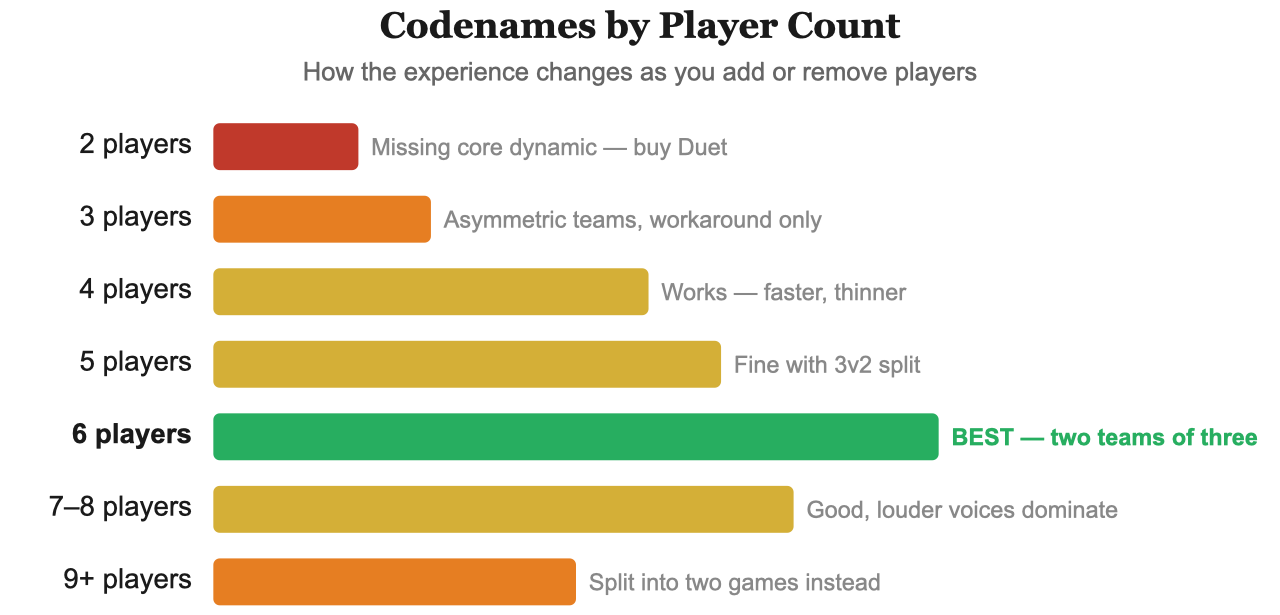
| Players | Experience |
|---|---|
| 2 | Missing the core social dynamic — buy Duet instead |
| 3 | Asymmetric teams, works as a workaround |
| 4 | Good — faster, less deliberation than 6 |
| 5 | Fine — slightly uneven teams (3v2 or designated observer) |
| 6 | Best — two teams of three, full experience |
| 7–8 | Good — slight loudness imbalance starts here |
| 9+ | Works, but two separate games is often better |
The box’s 2–8+ claim isn’t wrong — it’s just not the full story. Plan for six when you can. Four when you can’t. Save the two-player experience for Codenames Duet.
For everything else about the game — tips, rules, what to expect from the Spymaster role — our full Codenames review covers it all.
Don’t own Codenames yet? This guide assumes the base game.
Check Codenames price on Amazon →
Frequently Asked Questions
What is the minimum number of players for Codenames?
The official minimum is 2. In practice, you need at least 4 for the team dynamic to function — two players per team. With fewer than 4, each “team” is one person giving and one person receiving clues, which removes the deliberation that makes Codenames work as a social game.
Can you play Codenames with 5 players?
Yes. The cleanest setup is two teams of two with one person designated as a rotating observer or scorekeeper, or running a 3v2 split. Neither is ideal, but 3v2 is playable — the three-person team has a richer experience than the two-person team. If someone is new to the game, put them on the larger team as an operative so they can learn by watching others guess.
What’s the maximum number of players for Codenames?
There’s no official cap. In reality, once teams exceed four or five operatives, the game loses coordination and the loudest voice starts deciding every guess. For groups larger than 10, running two simultaneous games is a better experience than one oversized one.
Is Codenames better with 4 or 6 players?
Six. At four, each team has one operative per side, so there’s no team deliberation — your partner just guesses. At six, three operatives per team means real debate before each guess. The deliberation is where Codenames’ social layer lives, and six is the minimum count where it fully activates.
Can you play Codenames with just 2 players?
Technically yes, but you’re missing what makes the game fun. With two players, one person gives clues and the other guesses alone — there’s no team, no deliberation, no social tension. For a proper two-player Codenames experience, Codenames Duet is the designed solution. It’s a cooperative version built specifically for two, with a campaign mode and three assassins instead of one.