

Here’s the honest answer: Ticket to Ride with two players on the original North America map is fine. Not great — fine. The map is too big, competition for routes never gets tense enough, and the game ends without ever developing the blocking dynamics that make it interesting at three or four players.
Some links below are Amazon affiliate links — as an Amazon Associate, King Panda Games earns from qualifying purchases at no extra cost to you. Full disclosure.
Ticket to Ride won the Spiel des Jahres in 2004, the award that turned it into a gateway staple. See the jury’s entry.
But “the base game at two is mediocre” doesn’t mean “Ticket to Ride is bad at two players.” It means you’re using the wrong version.
The quick answer: yes, Ticket to Ride is genuinely fun at 2 players — just not the original North America map. Play Europe or Nordic Countries instead, and the two-player experience goes from flat to genuinely tense.
Choosing a copy specifically for two? Our version rankings and player-count guide cover every box in the series.
Why the Base Game Struggles at Two
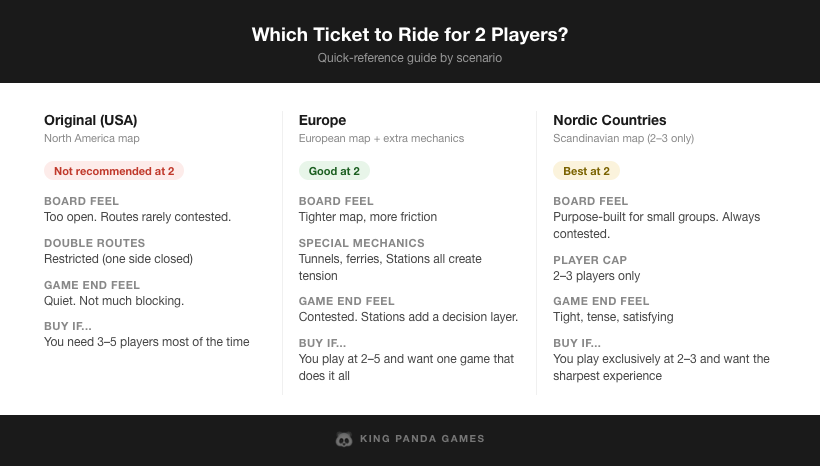
The North America map was designed for 3–5 players. At full count, the board fills up, routes get contested, and double routes create meaningful strategic tension. At two players, the same map produces a different experience entirely.
The critical rule: in 2-3 player games, only one of any double-route pair can be used by either player. So the two blue routes from Chicago to Pittsburgh become a single contested route. This is correct per the rules and intended to increase competition — but it doesn’t fully compensate for how much open space remains on the board.
You’re playing two players on the North America map. It’s round 8. Both players have built well-connected networks. Your opponent hasn’t touched the West Coast. You haven’t touched the South. The board looks half-empty. Neither player has been blocked once. The game ends shortly after with clean scores and no drama. It worked — it just didn’t feel like much.
This isn’t a rules problem. It’s a design-fit problem. The map simply doesn’t create friction with two players in a way that produces memorable moments.
What Actually Works: Ticket to Ride Europe
Europe is the right answer for two-player Ticket to Ride — not as a band-aid, but as a genuinely better game at this player count.
Three reasons:
Tunnels create uncertainty. On a standard route, you know exactly what a claim costs. Tunnel routes flip three additional draw pile cards and charge you for any that match your claimed color. Even with two players, tunnel routes feel risky and contested because the cost is variable. You can’t just assume you’ll have enough cards — you need buffer.
Ferries require Locomotive wildcards. Ferry connections in Europe need at least one Locomotive card per ferry segment. With only 14 Locomotives in the deck (same supply as the original), two players actively compete for a limited resource. The moment your opponent draws the Locomotive you needed from the face-up display, the impact is immediate and felt.
Stations change the calculus. Each player starts with three Stations in Europe. If a route you need is blocked, you can place a Station in one of its cities and use the route anyway — at a cost of 4 points per Station spent. At two players, Stations turn blocking from a game-ending frustration into a meaningful decision: is the route worth the 4-point penalty, or do I reroute? This dynamic is exactly what two-player Ticket to Ride needs.
The Purpose-Built Option: Nordic Countries
If two-player Ticket to Ride is your primary use case, Nordic Countries is the best purchase you can make. It’s a standalone game designed specifically for 2–3 players — not adapted from a larger map, but purpose-built for smaller groups.
The Scandinavian geography creates natural bottlenecks. The ferry routes through the Norwegian archipelago require Locomotives. The map is compact enough that both players are constantly aware of what the other is building. It plays in 45–60 minutes and produces consistently contested games.
The trade-off: it caps at three players. If you ever need to play with four or five, you need a different game. For dedicated two-player households, that’s not a trade-off at all.
Tips for Two Players on the Base Map
If you’re committed to the original map at two players, a few adjustments make it more interesting:
Standard rules at two: Double routes restricted, everything else as written. Results in a quiet, uncrowded game.
House rule worth trying: Allow both double routes to be available (remove the 2-3 player restriction). This increases competition and gives two players a full set of route options, which makes the map feel more appropriately dense.
This isn’t an official variant, and it changes the game’s balance — but many two-player groups find it produces a more engaging experience than the standard restricted rules.
A second adjustment: encourage both players to draw Destination Tickets aggressively early. More tickets means more geographic spread, which means more route overlap, which means actual competition. Two players each holding only two tickets rarely cross paths. Two players each holding four or five tickets are building all over the map.
The Verdict
Don’t buy the original Ticket to Ride as a two-player game. Buy Europe. If two players is your only scenario and you want the sharpest possible experience, buy Nordic Countries. If you already own the original and play exclusively at two, house-rule the double routes open and encourage more Destination Tickets.
The game itself is not the problem at two. The map is the problem. Match the map to your player count and Ticket to Ride works at any size. And if the two players are you and your partner, Ticket to Ride still makes our best board games for couples list — on the Europe map, not the one in most people’s closets.
Check Ticket to Ride: Europe price on Amazon →
For the full picture on the base game’s strengths and weaknesses across all player counts, check out our complete Ticket to Ride review. For a direct comparison between the original and Europe, we’ve got that breakdown here, and our full Europe review covers why it’s the version we recommend to most buyers.
Wondering what happens at the other end of the table instead? Our player count guide walks through what changes at three, four and five — and how to seat six.
What the critics said about Ticket to Ride
We play these games ourselves, but it’s worth knowing where the rest of the hobby lands.
-
“I’ve always thought this game was amazing, so why not invest in a very nice version of it?”
— The Dice Tower. From the Dice Tower’s 10th Anniversary edition review — the base game’s standing is not in question.
-
Shut Up & Sit Down — SU&SD’s review covers the base game alongside Rails & Sails, and is the best single argument for why the route-claiming loop still holds up.
Going straight to the source: Read the official Ticket to Ride rules, plus the background and history.
📕 Grabbing the rules? Grab this too.
The KPG Budget Board Games Guide — 9 games under $30, each with player counts, play time, and who it’s actually for. Free PDF, no email gymnastics.
Frequently Asked Questions
Can you play Ticket to Ride with two people?
Yes — every standard version of Ticket to Ride can be played with two people. The base game and Europe both officially support 2–5 players, and Nordic Countries is built specifically for 2–3. One rule changes with two people: only one route of any double-route pair can be claimed. Map choice matters more than the rules — Europe and Nordic Countries stay tense with two, while the original North America map plays quiet and open.
Is Ticket to Ride fun with 2 players?
On the Europe map or Nordic Countries map, yes — genuinely. On the original North America map, it works but feels flat. The base game’s map is too large and routes too uncrowded at two players to create the competitive tension that makes Ticket to Ride engaging. Europe’s tunnels, ferries, and Stations solve this problem.
What’s the best Ticket to Ride version for two players?
Nordic Countries if you play exclusively at 2–3 players. Ticket to Ride Europe if you want something that handles 2–5 players well. The original North America map is the weakest two-player experience in the franchise.
Can you play Ticket to Ride with 2 players without any house rules?
Yes. The official rules have a specific two-player rule: only one of any double-route pair between cities can be used. The game works as written, but the board stays uncrowded and blocking rarely happens on the North America map. It’s playable, just not the game’s best form.
Do you use double routes in a 2-player game?
According to the official rules, no — in 2 and 3-player games, only one of the double routes between any two cities can be claimed. The other is closed off entirely. Some players house-rule this away to increase route competition, which produces a more contested two-player experience.
How long does a 2-player game of Ticket to Ride take?
Typically 30–45 minutes. With two players, trains are placed slower and the game clock (triggered when someone reaches 0–2 trains) takes longer to expire. Europe or Nordic Countries at two players runs about the same length, occasionally 50–60 minutes if both players are building large, ambitious networks.
How many people can play Ticket to Ride?
The base Ticket to Ride (North America) officially supports 2 to 5 players. Ticket to Ride Europe also plays 2 to 5. Nordic Countries is capped at 2 to 3 players by design. Every version technically allows 2, but as this guide covers, not every map is equally good at that count.