

People ask this constantly: “Should I buy the original Ticket to Ride or Europe?” And the honest answer isn’t “they’re basically the same” — because they’re not. They share a core engine, but the map and mechanics create genuinely different experiences. Which one you should buy first depends on who you’re playing with and how often.
Some links below are Amazon affiliate links — as an Amazon Associate, King Panda Games earns from qualifying purchases at no extra cost to you. Full disclosure.
Here’s the breakdown, mechanic by mechanic.
The Core Game Is Identical
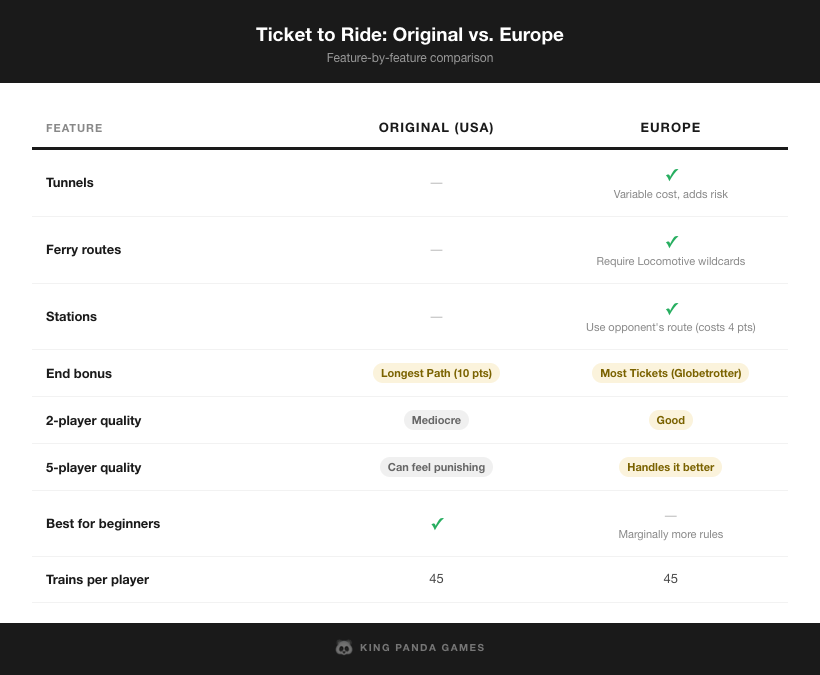
Start here, because it matters: the fundamental loop is the same in both versions. Draw cards, claim routes, complete Destination Tickets, score points. Route scoring is identical (1=1, 2=2, 3=4, 4=7, 5=10, 6=15). You still have 45 trains per player. The card colors and Locomotive rules are the same. If you’ve played one, the other takes five minutes to pick up.
The differences are in three Europe-specific mechanics and how they reshape the game’s pressure.
What Europe Adds: Tunnels
Tunnels are mountain routes that work differently from normal routes. When you attempt to claim a tunnel, you play the required set of cards — but then the game flips the top three cards from the draw pile. For each card flipped that matches the color you played (or is a Locomotive), you must pay one additional card of that color or a wildcard. If you can’t pay, you get your original cards back and the route goes unclaimed.
This changes how you plan. On a standard route, claiming a four-space blue route costs exactly four blue cards, full stop. On a tunnel, it might cost four, five, six, or seven — you can’t know in advance. Players have to decide how much buffer to keep in hand when going for a tunnel, and the randomness creates real tension at the table.
Worth knowing: Tunnel routes are often the highest-value routes on the Europe map. The risk is the price for access to the best scoring real estate on the board.
What Europe Adds: Ferries
Some routes in Europe are ferries — connections that cross bodies of water. Ferry routes require at least one Locomotive wildcard per ferry segment, with the remaining spaces filled by any single color. A ferry route might say it needs three cards with one Locomotive: you play one Locomotive and two cards of any matching color.
This makes Locomotive wildcards more structurally important in Europe than in the original. In the base game, Locomotives are a nice convenience — something you pick up when available. In Europe, specific routes require them. Your route plan has to account for Locomotive availability in a more intentional way.
What Europe Adds: Stations
This is Europe’s most significant departure from the original. Each player starts with three Stations — small plastic pieces. When a route you need is already claimed by another player, you can place a Station in one of the cities on that route. This lets you use the opponent’s route for the purpose of completing your Destination Ticket, at a cost: each unused Station adds 4 points to your final score. Every Station you spend costs you those 4 points.
In the original game: If a route you need is claimed, you find an alternative path or you’re out of luck. Blocking is permanent and consequential.
In Europe: Blocking is still meaningful, but Stations give players a lifeline. You can rescue a failed Destination Ticket, but it costs you. The game has a built-in safety valve that the original doesn’t.
Stations change the psychological dynamic of Europe considerably. In the original, watching someone claim a route you need produces a sick-stomach moment — that connection might be gone. In Europe, the same moment produces a calculation: is this worth a Station, or do I reroute? It’s a softer game for it, in a specific and intentional way.
The Maps Themselves
The North America map (original) is open and sprawling. The West Coast is relatively uncrowded; competition tends to concentrate in the central routes connecting Chicago, Kansas City, and Saint Louis. At two players, there’s so much map that the game rarely feels contested.
The Europe map is tighter. More of the valuable routes run through continental bottlenecks — Alpine passes, the areas around Paris, routes through Eastern Europe. The same number of players generates more visible competition because there are fewer alternative paths around contested areas.
This is why Europe plays better at two players than the original. See our full breakdown of what works (and what doesn’t) at two players. With two players on the North America map, double routes are restricted and the map never fills up enough to create real pressure. With two players on the Europe map, even without aggressive blocking, the tunnels and ferries create natural friction that makes the game feel meaningfully contested.
Which One Should You Buy?
You’re buying your first Ticket to Ride. You’ll primarily play with your family, including kids ages 9 and 12. You expect to play three or four players most of the time.
Buy the original. At three and four players, the base game’s cleaner rules mean less to explain, and the learning curve is gentler. Tunnels and ferries add texture but also add rules questions. For a group new to the game, that’s friction you don’t need. The North America map works well at three and four players.
Check the original Ticket to Ride price on Amazon →
Now flip that:
You and your partner play most board games together — typically just the two of you. You’ve heard good things about Ticket to Ride and want to try it.
Buy Europe. The base game is genuinely flat at two players. Europe’s added mechanics create the tension that makes a two-player game feel like a real contest. Tunnels introduce uncertainty, ferries create Locomotive competition, and Stations add a strategic decision layer that a two-player game benefits from.
Check Ticket to Ride Europe price on Amazon →
The summary:
– First-time players at 3–5 players → original
– Two-player primary use case → Europe
– Already own the original and want more depth → Europe
– Shopping for a gift and unsure of group size → original (wider player count feels smoother)
Frequently Asked Questions
Is Ticket to Ride Europe harder than the original?
Marginally. The three extra mechanics — tunnels, ferries, stations — take an extra ten minutes to explain and a half-game to internalize. For experienced players, Europe feels like the same game with more interesting decisions. For total beginners, the original is a slightly easier starting point.
Can you use Europe cards with the original game map?
No. The two games use different card sets and components. The train car colors don’t translate directly, and Europe has different Destination Tickets designed for its map. They’re standalone games, not interchangeable.
Which version is better for 5 players?
Europe handles five players better. The tighter map and Stations mechanic give players more flexibility when routes get blocked, which reduces the frustration that can come from a full five-player game on the original’s more open map. That said, both are solid at five — it’s a close call.
Is the Europe version more expensive?
They typically retail at the same price point. Both are in the $45–$55 range depending on retailer and timing. Neither is a budget upgrade over the other.
What if I want to buy both eventually?
Many families do end up with both. If that’s the plan, start with the original to learn the core game cleanly, then add Europe after your group has 3–4 plays under their belt. The transition is seamless — Europe’s additions feel natural once you know the base mechanics.
Does Europe have the Longest Path bonus?
No — Europe replaces the Longest Path bonus with the Globetrotter bonus, which goes to the player who completes the most Destination Tickets. This shifts end-game incentives slightly: Europe rewards completing more tickets rather than building the longest single network.
If you’re still on the fence about Ticket to Ride in general — whether it’s the right game for your group before deciding which version — start with our full Ticket to Ride review.