

Buy Skip-Bo if you mostly play with two people. Buy Phase 10 if you want one game for a mixed-age family table. Buy Uno if you need to seat seven to ten or want rounds that end in minutes. We rate Skip-Bo 5/5 Pandas, Phase 10 4/5 and Uno 2/5.
Some links below are Amazon affiliate links — as an Amazon Associate, King Panda Games earns from qualifying purchases at no extra cost to you. Full disclosure.
All three are Mattel card games built on numbered cards, and all three are rated for ages 7 and up. They play nothing alike. Skip-Bo is the oldest of the three: it has been sold since 1967, according to Wikipedia’s Skip-Bo entry.
| Skip-Bo | Phase 10 | Uno | |
|---|---|---|---|
| Created | 1967, Hazel “Skip” Bowman | 1982, Kenneth Johnson | 1971, Merle Robbins |
| Cards | 162 | 108 | 112 |
| Players | 2–6 | 2–6 | 2–10 |
| Age | 7+ | 7+ | 7+ |
| Goal | Empty your stock pile | Complete 10 phases in order | Empty your hand; first to 500 points |
| Hand size | 5 cards | 10 cards | 7 cards |
| Type of game | Sequencing race | Rummy | Matching |
| Play time on BoardGameGeek | 20 min | 45 min | 30 min |
| Our Bamboo rating (easy to learn) | 4/5 | 5/5 | 5/5 |
| Our Pandas rating (fun) | 5/5 | 4/5 | 2/5 |
Card counts and player counts come from Mattel’s rule sheets for Skip-Bo, Phase 10 and Uno.
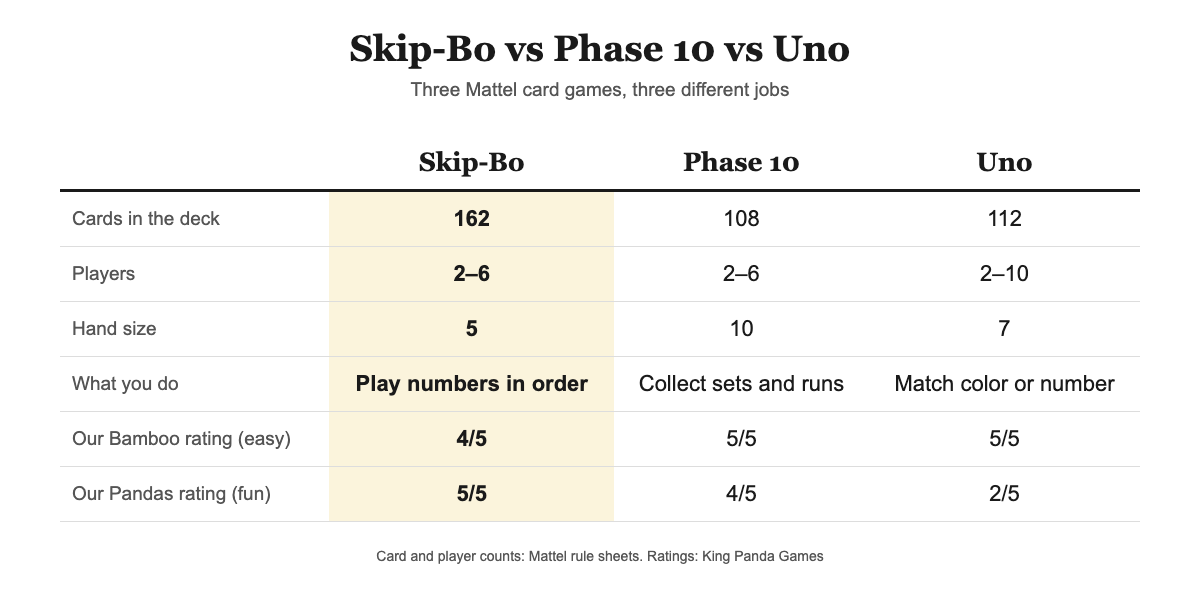
How the Three Games Actually Differ
Each game asks you to do a different thing with your cards. In Uno you get rid of them. In Phase 10 you collect them. In Skip-Bo you put them in order.
An Uno turn is a match: play a card that shares a color or number with the top of the pile, or draw. A Phase 10 turn is rummy: draw, keep what builds your sets and runs, discard the rest.
A Skip-Bo turn is a chain. You draw up to five cards, then play as many as you can onto shared piles that count from 1 to 12. The goal is to reach the face-up card on your own stock pile and play it.
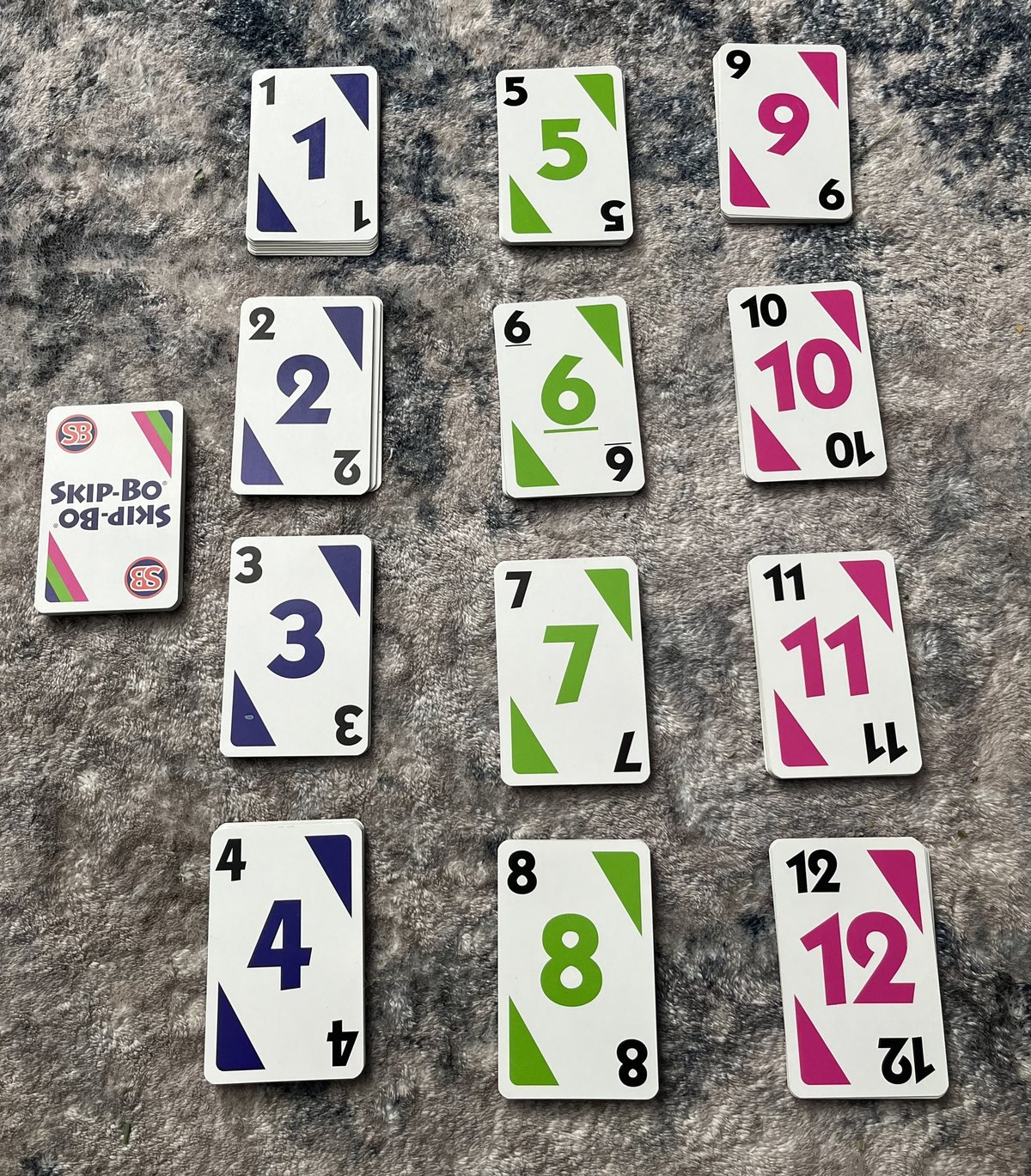
Skip-Bo is the only one of the three where colors mean nothing. The rule sheet never mentions them. Only the number counts.
Check Skip-Bo price on Amazon →
Which Is Easiest to Learn?
“Is Skip-Bo harder than Uno?” A little. Uno is the easiest of the three, Phase 10 is next, and Skip-Bo takes the longest to explain.
Uno has one pile and one rule: match the color or the number. Most people already know it. Phase 10 adds sets and runs, and the ten phases are printed on a reference card.
Skip-Bo has four kinds of piles: your stock pile, the draw pile, the shared building piles and your own discard piles. That’s why we give it 4/5 Bamboo and the other two 5/5. Each pile has one simple rule, so it isn’t much to learn.
Which Is Best for Two Players?
Skip-Bo. We think it’s at its best with four, and it’s still a great two-person game. It’s easy as a two-person game, and it’s our cheap date night: get some ice cream and play Skip-Bo.
What changes at two in the other games: Uno’s Skip and Reverse cards both just give you another turn, and Phase 10’s Skip always hits the same person.
What changes at two in Skip-Bo: nothing in the rules. Each player still gets a 30-card stock pile, the same as at three or four, and every block lands on the one player you’re racing.
Our Skip-Bo 2-player guide has the setup. If you play as a pair most nights, our best 2-player games list has more options.
Which Is Best for Big Groups?
Uno wins on player count. Uno seats 2 to 10. Skip-Bo and Phase 10 both stop at 6.
Skip-Bo does have one thing the others don’t: an official partnership variant. Teammates can play from each other’s stock and discard piles, and a team wins when both of its stock piles are gone.
For a party of eight, Uno is the only one of the three that works out of the box.
Which Takes Longest?
Phase 10 is the longest. A full game is at least ten rounds, and players repeat any phase they miss.
Skip-Bo sits in the middle. BoardGameGeek lists it at 20 minutes, but a full game with 30-card stock piles can run longer. The rule sheet’s short game deals 10-card stock piles, and that version is quick.
A single Uno round is the shortest of the three. So if you have ten minutes, play Uno or short-game Skip-Bo. If you have an evening, play Phase 10.
Check Phase 10 price on Amazon →
So Which Should You Buy?
- Two players, most of the time: Skip-Bo.
- A family of three to six with mixed ages: Phase 10.
- Groups of seven to ten: Uno.
- Something small to pack for a trip: Skip-Bo or Phase 10. Both are just a deck of cards.
- Kids who are still learning numbers: Uno first, then Skip-Bo.
These three don’t replace each other, so owning more than one is reasonable.
For the full picture on each, read our Skip-Bo review, our Phase 10 review and our Uno review. We also compare the other two head to head in Phase 10 vs Uno.
Frequently Asked Questions
Is Skip-Bo better than Phase 10?
For two players, yes. We rate Skip-Bo 5/5 Pandas and Phase 10 4/5. For a family table of four to six with mixed ages, Phase 10 is slightly easier to teach and just as good a buy.
Is Skip-Bo better than Uno?
We think so. We rate Skip-Bo 5/5 Pandas and Uno 2/5. Skip-Bo gives you more to decide each turn. Uno is the better choice only when you need to seat more than six players.
Are Skip-Bo and Uno made by the same company?
Yes. Mattel publishes Skip-Bo, Uno and Phase 10. Skip-Bo was created in 1967 by Hazel “Skip” Bowman, and Mattel has owned it since buying International Games in 1992.
Which has more cards, Skip-Bo or Uno?
Skip-Bo. It has 162 cards, against 112 for Uno and 108 for Phase 10. Skip-Bo needs the bigger deck because each player starts with a stock pile of 20 or 30 cards.
Can you play Skip-Bo with Uno cards?
Not well. Skip-Bo needs twelve copies each of the numbers 1 to 12 plus 18 wilds. An Uno deck only runs from 0 to 9 and has far fewer of each number.
Which is easiest for young kids?
Uno. Matching a color or a number is simpler than keeping track of Skip-Bo’s four kinds of piles. All three games are rated for ages 7 and up.