

Bottom Line
Munchkin is best for teens and adults who like to laugh, bargain and betray each other over a card game. Skip it if your group hates take-that games or wants something that reliably ends in under an hour. Its biggest strength is the table talk: every fight turns into a negotiation, a bribe or a backstab. Its biggest weakness is the ending, where everyone gangs up on the leader and the last few levels can drag.
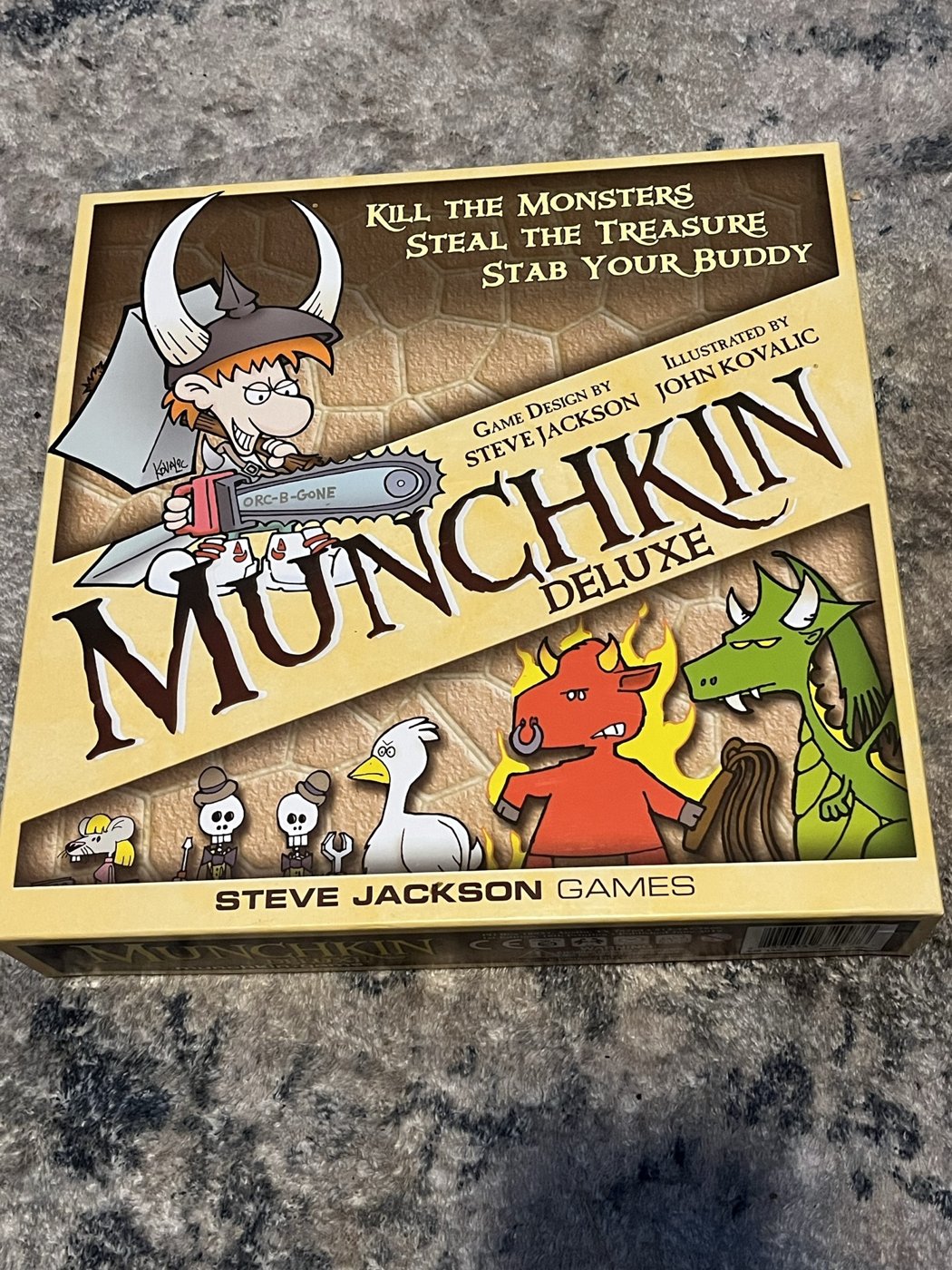
Munchkin gets 4/5 Bamboo Plants and 4/5 Pandas from us. We’ve played it 20-plus times, mostly with teens and adults, and our copy is Munchkin Deluxe, the version with a gameboard and standees.
The Bamboo is a 4 because the core loop is simple: open a door, fight what’s behind it, take the treasure. It isn’t a 5 because the cards keep adding exceptions, and the rulebook itself says disputes “should be settled by loud arguments.” The Pandas are a 4 because few games make a table laugh this hard. It loses a point for the slow, pile-on ending.
Some links below are Amazon affiliate links — as an Amazon Associate, King Panda Games earns from qualifying purchases at no extra cost to you. Full disclosure.
Check Munchkin Deluxe price on Amazon →
Munchkin is a card game that parodies tabletop roleplaying games like Dungeons & Dragons. You race to Level 10 by killing monsters, and everyone else at the table is trying to stop you.
| Detail | Info |
|---|---|
| Players | 3–6 |
| Best Player Count | 4 — enough rivals to bribe and backstab, short enough waits between turns |
| Age | 10+ |
| Play time | 60–120 min (box says 1–2 hours) |
| Complexity | Light to medium |
| Solo Mode | No |
| Designer | Steve Jackson |
| Artist | John Kovalic |
| Publisher | Steve Jackson Games |
| Popular Upgrades | Yes — the Deluxe board, level counters, card sleeves |
| Bamboo Plants | 4/5 — simple loop, lots of card exceptions |
| Pandas | 4/5 — huge laughs, slow ending |
| Official site | munchkin.game |
How Munchkin Works
Everyone starts as a Level 1 human with no class. Steve Jackson designed it in 2001, and Munchkin’s BGG page lists Deluxe as a later edition of the same game. The Deluxe box holds 168 cards: 95 Door cards and 73 Treasure cards, plus a gameboard, one die and 12 player standees, according to the official rules. You’re dealt four cards from each deck, and from there you collect Races (Elf, Dwarf, Halfling), Classes (Warrior, Wizard, Thief, Cleric) and gear.
Every turn follows the same three phases:
- Kick Open the Door. Flip the top Door card. If it’s a monster, you fight it. If it’s a Curse, it hits you right away.
- Look for Trouble or Loot the Room. If no monster showed up, either fight a monster from your hand or draw a second Door card face down.
- Charity. If you have more than five cards, give the extras to the lowest-level player.
Combat is simple math: your Level plus your item bonuses against the monster’s strength. Monsters win ties. Win, and you go up a level and draw the monster’s Treasure. Lose, and you have to Run Away, which means rolling a 5 or 6 on the die. If you fail, the monster’s “Bad Stuff” happens to you, from losing an item all the way to dying.
You’re a Level 6 Warrior with a +3 sword, fighting a Level 8 monster. You’re at 9, so you’re winning. Then another player plays an enhancer that adds +5 to the monster, and now it’s 13 to 9. You can ask one player for help, but they want half the treasure. Someone else offers to help for free, and you suspect they’ll betray you mid-fight. That negotiation is the real game.
If you’d rather watch a teach, the official Watch It Played Munchkin video covers a full turn in a few minutes.
The first player to reach Level 10 wins, but you have to kill a monster to get there. You can’t sell items or play a Go Up a Level card for the winning level.
Check Munchkin Deluxe price on Amazon →
What We Liked
The bargaining is the best part. Only one player can help you in a fight, so every tough monster becomes an auction. You can offer items, a share of the treasure, or promises you may not keep, and the haggling is half the fun.
Interference keeps everyone involved on other people’s turns. You can play monster enhancers, Curses or one-shot items into anyone’s fight, so nobody just waits. The rulebook even encourages it: playing a Curse on someone “just as he thinks he has killed a monster is a lot of fun.”
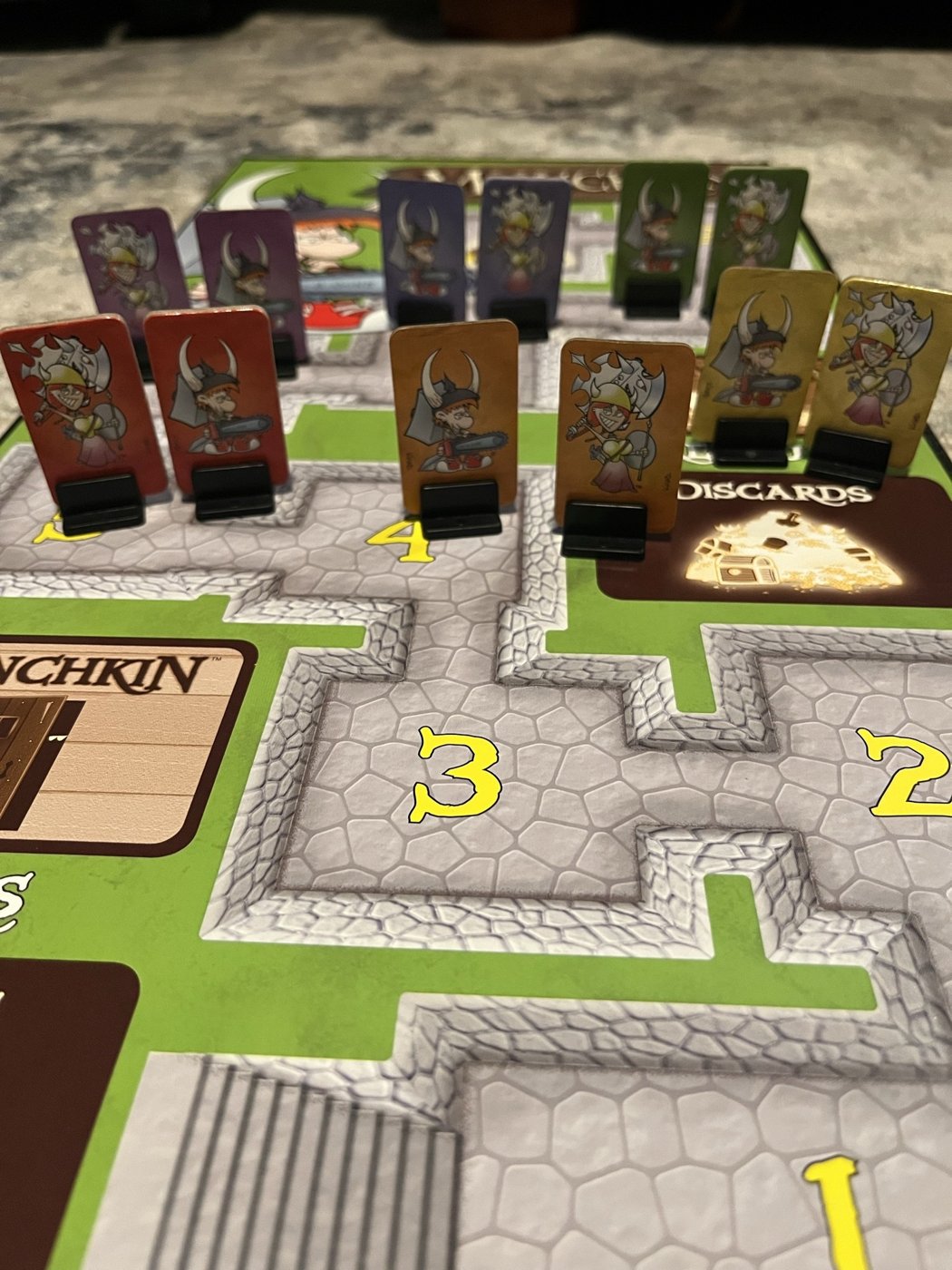
The Deluxe board is a real upgrade, not a gimmick. Moving a standee up a numbered track makes it obvious who’s about to win, which is exactly when the pile-on starts. The board also has marked spots for both decks and both discard piles, which keeps a sprawling card game tidy.
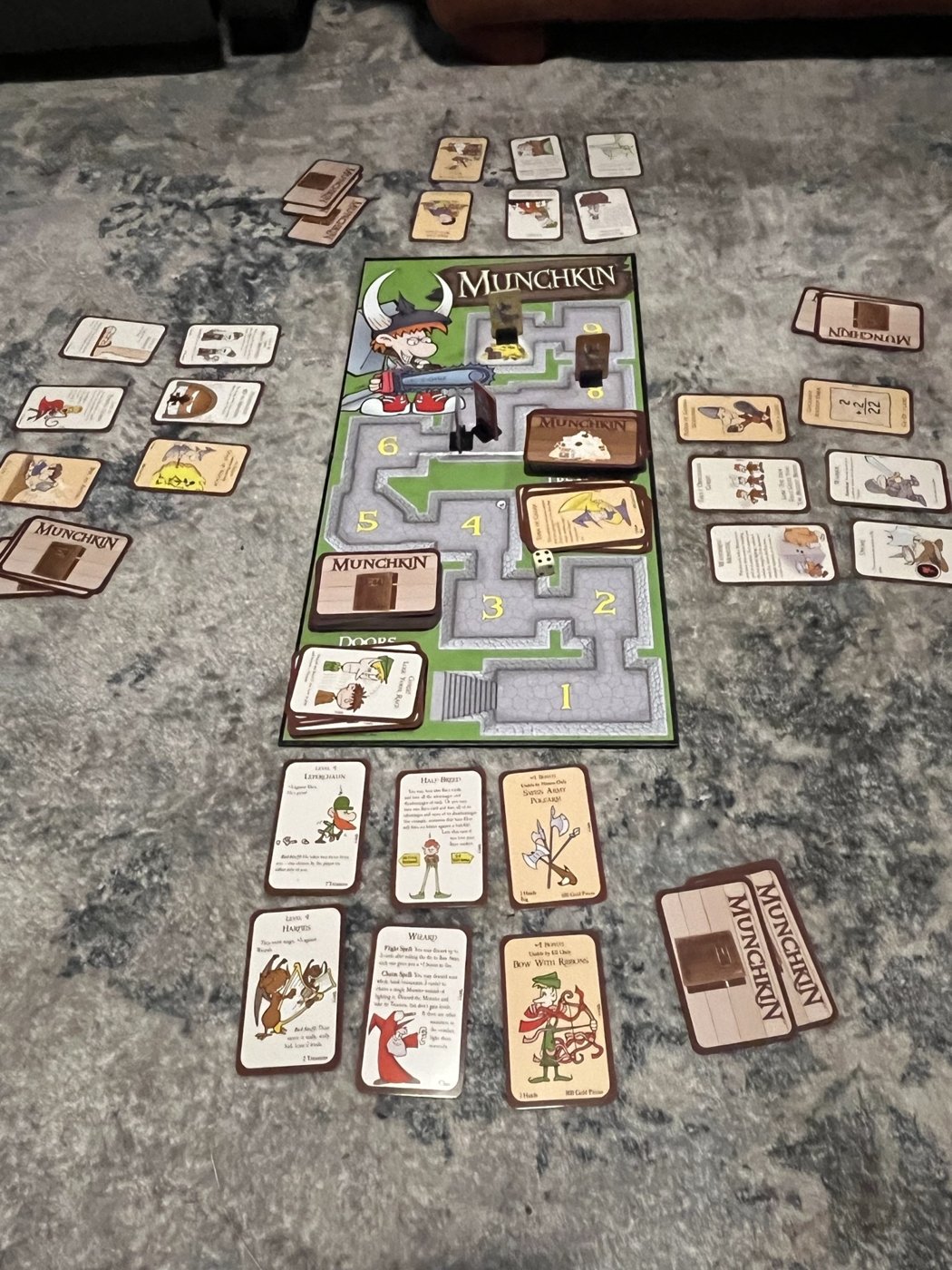
John Kovalic’s art and the card names carry it. The cards are full of jokes, like Boots of Butt-Kicking, the Chainsaw of Bloody Dismemberment and the Huge Rock. They’re funny the first time, and they keep landing because players read them out loud.
What We Disliked
The ending drags. Once someone reaches Level 8 or 9, everyone saves their best cards to stop them. That’s the design working as intended, but it can turn the last 20 minutes into a stalemate where three players take turns blocking each other.
There’s a lot of luck. Luck matters a lot: who draws the big monsters, the best gear and the strong Curses can outweigh good decisions. Players who want strategy to beat luck will be frustrated.
Rules arguments are part of the package. The cards often contradict each other, and the official answer is to argue. Some groups love that. Others will find it tiring.
Who It’s For
Munchkin is for teens and adults who enjoy talking, trading and betraying each other. It shines with groups who’d rather laugh than optimize, and it’s a strong pick for anyone who grew up on fantasy video games or Dungeons & Dragons.
It’s also a great step up for a family that has outgrown Exploding Kittens. It has the same silly tone but far more decisions, and it fits well on our best board games for teens list.
Who should skip this game:
– Groups that hate take-that games where you directly attack each other.
– Players who want a tight 45-minute game.
– Couples who mostly play two-player, since Munchkin needs at least three.
– Younger kids. The box says 10+, and some card jokes are aimed at adults.
Who Should Buy This?
Buy Munchkin if you have three to six teens or adults who like to talk while they play. It’s a core collection game for that kind of group, and it makes a strong Christmas gift for a teen.
Deluxe is the version we’d buy. The board and standees make levels easy to track and keep the cards organized, which matters in a game this chaotic. Steve Jackson Games lists Deluxe at $39.95, a little more than the $34.95 card-only core set.
If you’re buying new this holiday season, also look at the brand-new Munchkin Second Edition. It adds Gold Pieces, so you can get change when selling items, and lets a helper share the win. It also works with first-edition cards. Our versions guide compares all of them.
Check Munchkin Deluxe price on Amazon →
Best Player Count
Our pick is 4 players. The box says 3–6, and based on how the helping and bribing rules work, we’d rank it 4, then 5, then 3, then 6.
Four players gives you enough rivals to bribe and backstab, without long waits between turns. At five, the negotiations get wilder but the game runs longer. Three works, but with only two opponents, deals are easier to predict and there’s less chaos.
Six is our least favorite. Each player gets fewer turns per hour, and the pile-on at the end has more people to stop the leader, which stretches the game. Two players isn’t supported, since the official rules require at least three.
Replayability
Munchkin replays well because the table changes more than the cards do. The same 168 cards come out in a different order every game, and the deals, betrayals and grudges are new each time.
With only 168 cards, the base deck starts to feel familiar after a dozen or so games, once you know most of the monsters and items. That’s where the expansions come in. There are ten numbered sets, from Munchkin 2: Unnatural Axe to Munchkin 10: Time Warp (counting 6.5), and each adds new monsters, items and sometimes new races or classes. Our expansions guide lists them in order and covers which to buy first.
Accessories & Upgrades
Upgrades are optional, but two of them help.
- Level tracking. Deluxe already has a board for this. If you own the card-only core set, Steve Jackson Games sells counters, and the rulebook points to its free Level Counter app at levelcounter.sjgames.com.
- Card sleeves. Munchkin cards get handled and shuffled constantly, and official Munchkin sleeves exist. They’re worth it if your group plays often.
Awards
Munchkin won the 2001 Origins Award for Best Traditional Card Game, the year it came out.
Similar Games
If you like Exploding Kittens, try Munchkin. It has the same jokey card art and take-that tone, but you build a character over the game instead of just trying to survive. Munchkin is much longer and has far more decisions.
If you like King of Tokyo, Munchkin is the card-game cousin. Both reward pushing your luck and attacking whoever’s winning. King of Tokyo is faster and dice-driven, while Munchkin is longer and built around deals.
If you want backstabbing in 15 minutes, play Coup instead. Coup is all bluffing and betrayal with almost no luck, and a game takes a fraction of Munchkin’s length.
If you’re choosing between Munchkin and Here to Slay, we’d buy Munchkin first. Here to Slay is shorter, at 30 to 60 minutes, and it works with two players, but its fights are settled by a dice roll where Munchkin’s turn into a negotiation. Our Here to Slay vs Munchkin comparison covers which one fits your group.
Tips & Tricks
Hold your best one-shot items for the end. A +5 one-shot used to beat a Level 4 monster is wasted. Save it for the fight that gets you to Level 10, or the one that stops someone else.
What most new players do: fight every monster alone to keep all the treasure.
What actually works: ask for help early and pay for it. Giving away two treasures to win a fight still gets you a level, and levels win the game.
Remember that you escape on a 5 or 6, so Running Away fails two times out of three. Don’t Look for Trouble with a monster you can only beat if nobody interferes. Someone will interfere.
Sell items for levels when you can. Every 1,000 Gold Pieces of items you discard buys a level on your turn (except the winning level). Items sitting in your hand do nothing.
Worth knowing: the Elf race gives +1 to Run Away and a level for every monster you help someone else kill. That makes Elves the best helpers at the table, so expect to be asked for help a lot.
Watch whoever’s at Level 8 or 9 and save a Curse or a monster enhancer for their fight. The game is usually won or lost in the last two levels.
Frequently Asked Questions
Is Munchkin worth buying?
Yes, for groups of three to six teens or adults who enjoy negotiating and backstabbing. We rate it 4/5 Bamboo and 4/5 Pandas after 20-plus plays. Skip it if your group dislikes take-that games or wants a short game.
How long does a game of Munchkin take?
Usually one to two hours, which matches the box. Bigger groups and a slow pile-on at the end push it toward two hours. The rulebook’s optional faster-play rules can shorten it.
Can you play Munchkin with 2 players?
Not officially. Munchkin Deluxe is for 3 to 6 players, and the game depends on having more than one rival to bribe, help and backstab.
Is Munchkin good for kids?
It’s rated 10+, and it works best for teens. The rules are easy enough for younger players, but the game is long, the jokes lean toward adults, and getting ganged up on can frustrate young kids.
What is the difference between Munchkin and Munchkin Deluxe?
Both have the same 168 cards. Deluxe adds a gameboard with a level track and spots for each deck, plus 12 player standees and plastic stands. It lists for $39.95 against $34.95 for the card-only core set.
Can you sell items to reach Level 10 in Munchkin?
No. You can sell 1,000 Gold Pieces of items for a level at any other time, but the winning level has to come from killing a monster. A Go Up a Level card can’t give you Level 10 either.
Do monsters win ties in Munchkin?
Yes. Your combat strength must be higher than the monster’s, so a tie means you lose and have to Run Away. Warriors are the exception, since their class ability lets them win ties.
Check Munchkin Deluxe price on Amazon →
Want to go deeper?
- Munchkin versions compared — Original, Deluxe, Big Box and the new Second Edition, and which one to buy. Read it here
- Munchkin expansions in order — all ten numbered sets, and which to buy first. Read it here
- Munchkin rules explained — combat, Running Away, Charity and how to win. Read it here
- Best race and class in Munchkin — every base-game Race and Class, ranked. Read it here
Verdict
Buy it if you have three to six teens or adults who love to laugh, bargain and betray each other. Skip it if you want a short game, a strategy game, or a two-player game. Get Deluxe if you can, because the board keeps a chaotic game organized.
Munchkin Deluxe official site: munchkin.game