

How to Win at Ghost Stories: A Strategy Guide for Beginners
You’ve lost four times in a row. The board collapsed before Wu-Feng even showed up. You’re starting to wonder if this game is actually winnable or if you’re just missing something fundamental.
Some links below are Amazon affiliate links — as an Amazon Associate, King Panda Games earns from qualifying purchases at no extra cost to you. Full disclosure.
You’re missing something fundamental.
Ghost Stories isn’t a fair game, but it is a learnable one. There’s a real gap between groups that always lose and groups that win consistently, and it’s not about luck. It’s about five principles that experienced players internalize — principles that almost no one discovers on their own in the first few sessions.
Before diving in, if you’re still on the fence about whether Ghost Stories is worth the learning curve at all, read our full Ghost Stories review first. This guide assumes you already know the basics and want to start actually winning.
Principle 1: Triage, Not Whack-a-Mole
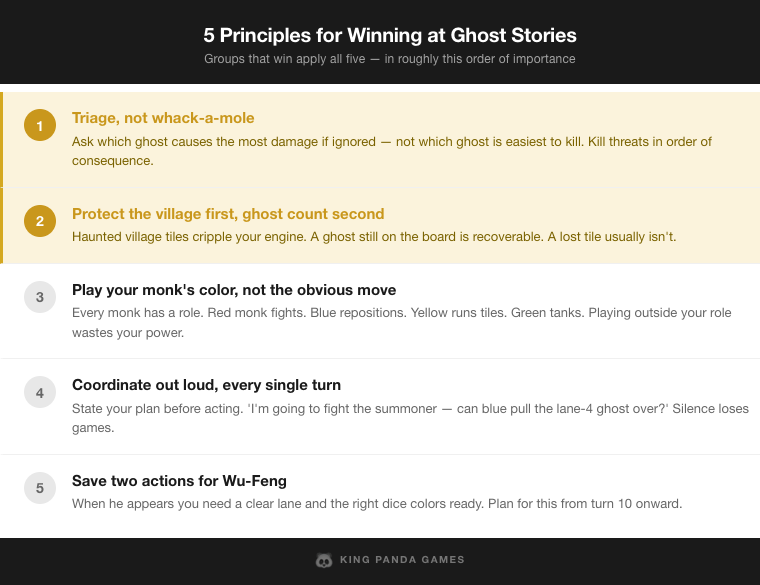
The most common mistake beginners make is fighting whichever ghost is most threatening right now without thinking about what becomes threatening next turn. This leads to the board filling up in unexpected places while you were busy elsewhere.
Experienced players think in terms of triage: what will kill us this turn, what will kill us in two turns, and what can we safely ignore for now?
A ghost that’s been sitting in a lane for three turns and hasn’t activated its haunt ability is less urgent than a ghost that just appeared with an ability that triggers on the *next* round. Learn what each ghost does before deciding whether to fight it immediately. Some ghosts are only dangerous if left alone for multiple turns. Others need to be eliminated the turn they appear.
The rule of thumb: always handle ghosts that threaten village tiles immediately. Village tiles are your engine. Lose them and you lose the game slowly but inevitably.
Principle 2: The Village Is Your Priority, Not Ghost Count
New players celebrate when they clear ghosts. Experienced players celebrate when they protect village tiles.
This sounds like the same thing but it isn’t. The village tiles are what let you fight effectively in the second half of the game. The tile that gives you extra Tao tokens, the one that lets you re-roll dice, the one that reveals the next ghost before it’s placed — these are what keep you alive when the ghost density gets high. If three of your nine village tiles are haunted by turn eight, you’re not just losing space. You’re losing capabilities.
In the first half of every game, ask one question before each fight: is this ghost threatening a tile we need? If yes, it’s your highest priority regardless of what else is happening. If no, it might be worth delaying while you address something more urgent.
The late game in Ghost Stories is won or lost by what you protected early.
Principle 3: Play Your Color, Not the Obvious Move
Every monk has a specific power. That power isn’t a nice bonus — it’s your primary job.
The failure mode looks like this: the blue monk sees a hauntable ghost in their lane, rolls dice, fails, and is now stuck with a haunted tile. Meanwhile, the ghost in the adjacent lane that the blue monk could have repositioned for the red monk to kill efficiently went untouched and activated its haunt ability.
Before every action, ask: what does my monk’s power enable *right now*? The yellow monk’s free movement means they should almost always be positioning to use village tiles or support another lane. The blue monk should be scanning adjacent lanes for ghosts that other monks are better equipped to fight. The red monk’s re-roll is wasted if they’re fighting ghosts they could already beat on the first roll.
Playing your color means resisting the urge to do the obvious thing and doing the *right* thing for your role instead.
Principle 4: Coordinate Out Loud, Every Turn
Ghost Stories punishes silent play harder than almost any other cooperative game. You cannot hold the whole board in your head. Your teammate might see something in their lane that changes the calculus for your action this turn.
The most effective Ghost Stories groups develop a short verbal loop at the start of each turn: what’s the most urgent threat on the whole board, who’s best positioned to handle it, and what does everyone else do in the meantime?
This doesn’t need to be long. It takes ten seconds. “I’ve got a haunt trigger in my lane this turn, blue — can you pull that summoner so I can clear it before it activates?” That one sentence changes the outcome of the next three turns.
The groups that struggle most are the ones where each player focuses only on their own lane. Ghost Stories is designed to overwhelm any single player’s lane. The whole board needs to be treated as a shared problem, not four separate problems happening simultaneously.
Principle 5: Save Two Actions for Wu-Feng
This is the principle nobody teaches new players and everybody learns by losing.
Wu-Feng appears at the end of the ghost deck. When he shows up, you need at least one lane clear enough to place him, and you need the right dice colors to fight him. If your board is completely locked up when he appears — every lane full, every monk cursed or exhausted — the game ends immediately regardless of how well you played the rest of it.
The practical application: starting around the middle of the game, designate one lane as Wu-Feng’s lane. Don’t let it fill up. Keep it clear even if it means letting a different lane get more crowded than you’d like. Make sure at least two monks are in a position to contribute dice to Wu-Feng’s fight.
You don’t need to plan five turns ahead for this. You just need to make it a standing priority from the midpoint on: Wu-Feng is coming, and we need to be ready.
Putting It Together
Win a game by applying all five at once and it clicks: you’re triaging threats instead of reacting, protecting the village tiles that matter, each monk is playing their role rather than the obvious move, your group is talking every turn, and you’ve been clearing Wu-Feng’s lane for the last six rounds.
When that game ends in a win — when you defeat Wu-Feng on the last possible action with one monk standing — it’s genuinely one of the best moments in tabletop gaming.
The losses before that moment aren’t wasted. They’re how you learn what these principles actually mean in practice.
Start on Initiate. Win it three times. Then move up to Student and use everything you learned.
Don’t own Ghost Stories yet? This guide assumes the base game.
Check Ghost Stories price on Amazon →
Frequently Asked Questions
Is Ghost Stories actually winnable, or is it just too hard?
Absolutely, Ghost Stories is winnable, despite its brutal difficulty. The game isn't about luck; it's about internalizing specific strategic principles that experienced players consistently apply. You're likely missing fundamental strategies rather than facing an unwinnable challenge.
What's the biggest mistake beginners make in Ghost Stories?
The most common beginner mistake is fighting ghosts reactively, like a game of whack-a-mole, without considering future threats. This leads to the board quickly becoming overwhelmed in unexpected areas. Instead, you must think strategically about what will kill you in one or two turns.
How should I prioritize which ghosts to fight in Ghost Stories?
Experienced players prioritize ghosts using a triage approach: identify what threatens you this turn, what will be critical next turn, and what can be safely ignored. Always handle ghosts that threaten village tiles immediately, as these are your game's engine and losing them is a slow, inevitable defeat.
Should I focus on clearing as many ghosts as possible in Ghost Stories?
No, focusing solely on clearing ghosts is a common misconception that often leads to losses. While clearing ghosts is necessary, your primary goal should be protecting your vital village tiles. Experienced players celebrate securing village tiles, not just reducing the ghost count, because these tiles are crucial for your long-term survival.
Why are village tiles so important in Ghost Stories?
Village tiles are critically important because they are the 'engine' of your game, providing essential actions and abilities. Losing these tiles cripples your ability to fight back and manage the board, leading to a slow but inevitable defeat. Prioritizing their protection is paramount for victory.
Is winning Ghost Stories mostly about luck?
No, winning Ghost Stories is definitively not about luck; it's about skill and strategy. There's a significant, consistent gap between groups that always lose and those that win regularly, which stems from understanding and applying core principles rather than fortunate dice rolls. Don't blame bad luck; learn the game's deeper strategies.
What's the fundamental difference between groups that win and groups that lose consistently?
The fundamental difference lies in internalizing and applying five core strategic principles that beginners rarely discover on their own. Winning groups understand triage, prioritize village tiles, and make proactive decisions, while losing groups often react to immediate threats without a broader strategy. It's a learnable skill, not an innate talent.