

Ghost Stories Review: Is It Worth It?
Ghost Stories earns a 4/5 Pandas and 2/5 Bamboo Plants — and we mean both of those scores fully. This cooperative board game is one of the most tense, satisfying experiences we’ve had at the tabletop. It’s also one of the hardest games we’ve ever played. You will lose. A lot. Whether that sounds like a nightmare or a challenge worth accepting is the whole question, and by the end of this review you’ll know exactly which camp you’re in.
Some links below are Amazon affiliate links — as an Amazon Associate, King Panda Games earns from qualifying purchases at no extra cost to you. Full disclosure.
Buy it if your group loves cooperative games and wants something that actually fights back. Skip it if you’re looking for a casual game night or your group has a low frustration tolerance. Try before you buy if you’ve only played lighter co-ops like Forbidden Island — Ghost Stories is a completely different difficulty class and you should know what you’re signing up for.
| Detail | Info |
|---|---|
| Players | 1–4 (best at 3–4) |
| Age | 12+ |
| Play time | ~60 min |
| Bamboo Plants | 2/5 — complex setup, lots of rule exceptions |
| Pandas | 4/5 — tense, rewarding, and genuinely exciting |
| Official site | repos-prod.com |
How Ghost Stories Works
You and up to three friends play Taoist monks defending a Chinese village from an army of ghosts led by Wu-Feng, the lord of hell. Your goal: survive long enough to defeat him. His goal: haunt your village into the ground before you get the chance.
The board is a 3×3 grid of village tiles, each one offering a special power — extra dice, Tao tokens, healing, the ability to reveal ghost cards before they’re placed. Surrounding that grid on all four sides are ghost lanes, one per player, where ghosts appear and slowly advance on the village.
Every turn, three bad things happen before you get to do anything good. First, a village tile gets haunted — cursed and locked down so you can no longer use it. Second, a ghost card is drawn from the deck and placed in one of the lanes. Third, your monk takes an action: move to an adjacent tile, fight a ghost in your lane, use a village tile’s power, or give Tao tokens to a teammate.
Fighting ghosts is done with colored dice. Each ghost card shows a combination of colors — red, black, blue, yellow — that you have to roll to defeat it. Roll a full set of matching colors and the ghost is gone. Miss even one symbol and it stays. Certain ghosts have special abilities that trigger if you don’t fight them fast enough: they curse monks, destroy village tiles, summon additional ghosts, or stack a second specter on top of themselves to make the fight even harder.
Here’s what makes it brutal: the more ghosts that fill a lane, the harder it becomes to navigate the board, because your monk can’t enter a space occupied by a ghost without fighting it first. As the game progresses, your mobility gets choked off. The village tiles you need most become inaccessible. And the whole time, Wu-Feng is getting closer to the top of the deck.
You win by defeating Wu-Feng when he appears at the end of the ghost deck. You lose if three village tiles get haunted, if all monks die, or if Wu-Feng shows up but can’t be placed because every ghost lane is already full. That third loss condition sneaks up on you in ways you don’t see coming your first several plays.
Each of the four monks is a different color with a unique power that changes how you play. The red monk can re-roll any single die once per turn — straightforward combat edge. The blue monk can pull a ghost from an adjacent lane into their own, which sounds weird until you realize it lets you cluster ghosts for efficient clearing. The yellow monk gets free movement, making them the best tile-runner on the board. The green monk starts with an extra life, which doesn’t sound dramatic until turn 8 when everyone else is on their last hit point and the green monk is still healthy.
Coordinating those four powers is the actual game. Ghost Stories isn’t about being the best dice roller. It’s about figuring out which monk needs to be where, which ghost is the real threat, and whose turn it is to sacrifice a bad roll so that someone else can swing the critical fight.
That coordination is also what makes the learning curve so steep. The turn structure is simple. The strategy is not. New players spend their first three or four games just learning what the ghosts do. Experienced players start mapping the whole board two turns ahead. The gap between those two states is real, and the only way to cross it is reps.
What We Liked
The tension is unlike anything else. We’ve played a lot of cooperative games. Pandemic, Arkham Horror, Spirit Island — all of them build pressure in their own way. Ghost Stories builds a specific kind of dread that those games don’t quite replicate: the dread of watching a disaster unfold in slow motion. You can see the ghost that’s going to haunt the tile you need. You can see the lane that’s about to overflow. You just don’t have the actions to stop all of it. The turns where you have to make a genuine triage call — save the village tile or save the monk — are the ones you’ll still be talking about after the game ends.
Every monk genuinely matters. In a lot of cooperative games, some roles feel like afterthoughts and others do most of the heavy lifting. Ghost Stories doesn’t let that happen. The game is tuned assuming all four monks are being used actively and correctly. We figured this out the hard way — during one session, our blue monk spent two rounds ignoring their repositioning ability and just trying to roll dice against ghosts in their lane. The board state deteriorated so fast it shocked us. The second we started using the repositioning power the way it was designed, the whole game opened up. That moment of “oh, THAT’S what this does” is genuinely satisfying game design.
It kills the alpha player problem. In lighter cooperatives, there’s usually a moment where the most experienced player starts telling everyone else what to do, and the game becomes one person playing while everyone else follows instructions. Ghost Stories is too hard for that to work. There are too many simultaneous threats for any one person to hold the full picture. The ghost lanes are all happening at once, the village is deteriorating from multiple angles, and the right move in one lane often creates a problem in another. The game forces everyone to think independently and communicate, not just receive orders. Groups that play this way tend to win. Groups that let one person drive tend to lose.
The difficulty levels are well-calibrated. Ghost Stories has four difficulty levels: Initiate, Student, Veteran, and Master. Each one adds progressively nastier ghost cards to the deck. The gap between Initiate and Student is real. The gap between Student and Veteran is significant. Veteran is for groups that have genuinely mastered the game. Master is for people who want to suffer with intention. We’ve spent most of our time at Student, occasionally dipping into Veteran when we’re feeling confident. Initiate is not a beginner’s mode in a pejorative sense — it’s a fully functional version of the game that removes the most punishing ghosts so you can learn the system. Win it a few times, then move up.
The theme earns its place. Antoine Bauza — the designer who later made 7 Wonders and Hanabi — built mechanics that actually feel like what they’re supposed to be. Monks pray for Tao tokens at village tiles, which is your currency for re-rolls and abilities. Ghosts haunt and curse and corrupt, which is what ghosts do. Wu-Feng feels like a final boss, not just a tough card. A lot of games put a theme on top of a mechanism. Ghost Stories feels like the theme and the mechanism were designed together, and you can feel it at the table.
What We Disliked
The rulebook is rough. Setup for a first-time game takes close to 45 minutes if you’re reading the rulebook carefully, and you will still make mistakes. The edge cases are everywhere: what exactly happens when a ghost haunts a tile that’s already been used? What does “curse” mean for movement versus actions? When a ghost summons another ghost, where does the new one go? We got one rule wrong in our first game, played three rounds that way, realized it, and had to decide whether to restart or just acknowledge the misplay and continue. Watch a video playthrough before your first session — there are good ones online and they’ll save you significant frustration.
Some losses feel unfair rather than instructive. Ghost Stories is designed to be hard, and we respect that. But there are moments where the ghost deck just gives you three consecutive cards that all target the same lane with the same haunt ability, and the game ends before you’ve had a meaningful chance to respond. Good players get fewer of these moments because they’re better at managing board state to reduce exposure. But newer players will occasionally lose to the deck rather than to their decisions. That’s a design tradeoff that experienced players accept. Some groups never make peace with it.
Solo mode is a different game. The single-player version has you controlling all four monks simultaneously. It works, and it’s a legitimate challenge — but it’s a solo puzzle, not the frantic real-time cooperation that makes the 3–4 player game so good. If you’re buying Ghost Stories primarily to play solo, it’ll satisfy you, but you’re playing a fundamentally different experience than what most people love about this game.
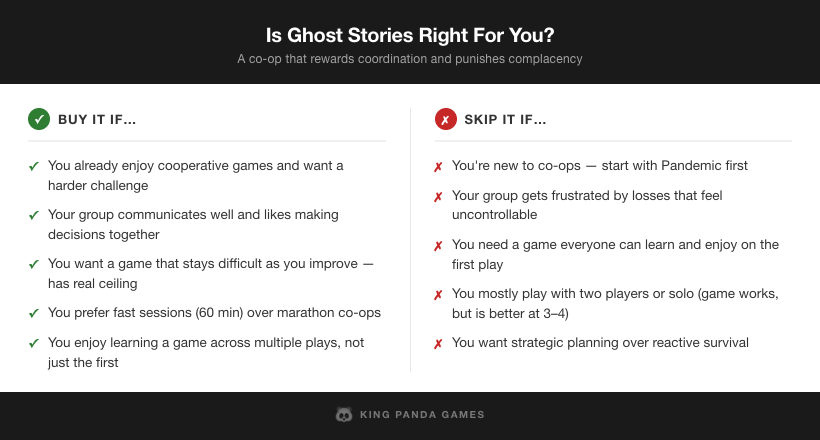
Who Ghost Stories Is For
Ghost Stories is built for groups that already enjoy cooperative games and want a real challenge. If your table has beaten Pandemic on Heroic difficulty and is wondering what’s next, this is the answer.
It plays best at three or four players. Two is manageable but the monk synergies feel thinner. Solo works as a puzzle game. Four is the full experience — all four monk powers in play, all four lanes needing attention, everyone genuinely needed.
It’s a particularly strong pick for couples or small friend groups that communicate well under pressure. Ghost Stories rewards calm, fast collaborative decision-making. It punishes panic and it punishes one person trying to micromanage everyone else. Groups that have played enough cooperative games to trust each other’s judgment — “you handle your lane, I’ll handle mine, let’s talk about Wu-Feng” — are the groups that win.
It’s not right for families with kids under 12. The age rating is honest. The rule density is real, and the unforgiving difficulty makes it deeply frustrating for players who haven’t built their board game muscles yet. It’s also not right for game nights that are primarily social events. Ghost Stories demands full attention. You can’t really hold a separate conversation while playing — the game doesn’t allow the mental space for it.
If your group loved Pandemic but found it started feeling solvable after enough plays, Ghost Stories will reset that feeling entirely. If your group bounced off Pandemic because it was too stressful, Ghost Stories will be more intense, not less.
Check Ghost Stories price on Amazon →
Awards
Ghost Stories received significant critical recognition when it released in 2008. Antoine Bauza, the designer, went on to win the Spiel des Jahres in 2012 with 7 Wonders — a completely different game that shows just how broad his design range is. Ghost Stories remains one of the most celebrated cooperative board games of the 2000s and is frequently cited as the game that raised the bar for cooperative difficulty.
How Ghost Stories Compares
Pandemic is the most natural comparison [link: once published, link to /pandemic-review/]. Both are cooperative games with an escalating threat that moves faster than you can fully contain. Both reward role specialization. But they feel completely different at the table.
Pandemic is a long-range planning game. The threat escalates predictably enough that experienced players can look several turns ahead and map out the most efficient path through the problem. Ghost Stories is more reactive. The ghost deck has genuine randomness baked in, and some draws will put you in situations no amount of foresight could have prevented. You’re adapting and solving in real time more than you’re executing a plan.
If Pandemic is chess, Ghost Stories is chess where someone occasionally shakes the board a little. You still need strategy. You just also need to survive the surprises.
Arkham Horror sits in similar thematic territory — cooperative, horror-adjacent, punishing. But Arkham plays in three to four hours and Ghost Stories finishes in about sixty minutes. If your group wants the high-stakes cooperative experience but needs it to fit inside a game night, Ghost Stories is the more accessible choice on time alone.
Spirit Island is what you play after Ghost Stories if you want even more depth. It’s the more complex, more variable, more replayable cooperative game. But it’s also a two-to-three-hour commitment with a significant learning curve. Ghost Stories fits in the middle — more depth than Pandemic, less commitment than Spirit Island.
Tips & Tricks for Ghost Stories
Start on Initiate. It’s not cheating. We’ve watched groups insist on playing the base difficulty and quit after three straight losses without ever getting close to Wu-Feng. Initiate removes the most punishing ghost cards from the deck. You still lose sometimes. But you get enough breathing room to actually understand the game instead of just watching it collapse around you. Win Initiate consistently, then move to Student. The skills transfer directly.
Protect your village tiles in the first half. The village is your engine. Specific tiles — the one that lets you re-roll dice, the one that grants extra Tao tokens, the one that lets you exorcise a ghost without rolling — are what keep you alive in the late game. If those get haunted in turns three through six, you’re fighting the back half of the game without tools you need. In the first half, fighting any ghost that’s threatening a critical tile is usually the right call, even if there are numerically larger threats elsewhere.
The blue monk is a support character, not a fighter. New players see four monks and assume everyone needs to be clearing ghosts. The blue monk’s primary power — pulling a ghost from an adjacent lane into their own lane — is a repositioning tool. Use it to cluster multiple ghosts into a single lane so a monk with combat advantages can clear them efficiently. A blue monk turn spent repositioning is often worth more than a blue monk turn spent rolling dice against ghosts they’re not well-suited to fight.
Spend Tao tokens aggressively; don’t save them. Tao tokens are the game’s reroll currency and village activation resource. New players hoard them and wait for a desperate moment. Experienced players spend them proactively, on fights they’re close to winning, and trust that the village tiles will generate more. A Tao token spent turning a near-miss into a successful exorcism is more valuable than a Tao token held back for a critical roll that’s going to fail anyway.
Plan for Wu-Feng before he shows up. Every game, there’s a moment — usually around the halfway mark — where the group should pause and have a 60-second conversation: which lane will be clear when Wu-Feng appears? Who has the right dice colors to fight him? What village tiles are still functional? Wu-Feng requires a specific color combination to defeat, and you need at least one lane open to place him. Groups that think about this proactively beat Wu-Feng. Groups that improvise usually don’t.
Track which ghost abilities are still in the deck. This is the advanced tip, and it takes several plays before you can do it reliably — but experienced Ghost Stories players pay attention to which ghost cards have already been drawn so they can estimate what’s still coming. If the ghost that destroys village tiles has already appeared, that threat is lower. If the summoner ghost is still in the deck, you want to clear lanes before it shows up. You don’t have to be perfect at this. Just being aware of it changes how you allocate attention.
Want to Go Deeper?
- How to Win at Ghost Stories: A Strategy Guide for Beginners — The five principles that separate groups who always lose from groups who actually finish the game. Read it here
- Ghost Stories Difficulty Levels Explained — A breakdown of Initiate through Master, what changes at each level, and which one to start on. Read it here
- Ghost Stories Monk Powers Guide: Which Color to Pick — A deep look at all four monk abilities and how to coordinate them effectively as a team. Read it here
- Ghost Stories vs Pandemic: Which Co-op Should You Buy? — If you’re choosing between the two most popular cooperative board games, here’s our honest side-by-side. Read it here
Verdict
Buy it if your group loves cooperative games and is ready for something with real teeth. The difficulty is the point. Ghost Stories is designed to make you feel the pressure of a village about to fall, and when you pull out a win — especially your first win — it’s one of the best feelings in board gaming. It’s the kind of game where people slap the table and shout when the dice finally go right on the last possible turn.
Skip it if you want something approachable or if your group has a low tolerance for losing. There are excellent cooperative games that are kinder to newer players. Start there.
Try before you buy if you’re not sure your group handles frustration well. Find someone who owns it and play one session. You’ll know within a single loss whether this is your kind of challenge or not.
Ghost Stories official site: repos-prod.com
Frequently Asked Questions
Is Ghost Stories a difficult board game?
Absolutely, Ghost Stories is one of the hardest cooperative games you'll ever play. You will lose, a lot, so only accept this challenge if your group genuinely enjoys a brutal tabletop experience that truly fights back.
How many players is Ghost Stories best for?
Ghost Stories plays 1-4 players, but we strongly recommend it with 3-4. The game's intricate mechanics and the need for coordinated strategy truly shine when you have a full team of monks working together to defend the village.
What kind of game is Ghost Stories?
Ghost Stories is a tense, cooperative board game where Taoist monks defend a Chinese village from an army of ghosts. It's a deeply satisfying experience for groups who love a challenge, but definitely not for a casual game night.
Is Ghost Stories worth buying?
If your group thrives on cooperative games that genuinely push back and you have a high frustration tolerance, then yes, Ghost Stories is absolutely worth it. However, if you're seeking a light, casual experience, you should definitely skip this one.
What makes Ghost Stories so frustratingly hard?
Ghost Stories is brutal because the game constantly chokes off your options, not just through bad luck. Every turn, village tiles get haunted and ghosts block movement, making crucial powers inaccessible and forcing difficult choices under immense pressure.
Is Ghost Stories similar to Forbidden Island?
While both are cooperative, Ghost Stories is in a completely different difficulty class than lighter co-ops like Forbidden Island. Don't go in expecting a gentle introduction; this game is a relentless, punishing experience designed to make you sweat.
How long does a game of Ghost Stories usually take?
A typical game of Ghost Stories clocks in at around 60 minutes. However, be prepared for that hour to feel incredibly intense and stressful, as every decision matters in your desperate fight against Wu-Feng's spectral army.