

Every Catan Expansion Ranked: Which One Should You Buy First?
Catan has been around since 1995 — more than thirty years. It’s accumulated a lot of expansions — some essential, some forgettable, and at least one that should probably be avoided entirely. If you’ve played the base game enough to start feeling restless, the right expansion doesn’t just add content. It changes the game. If you’re choosing between those standalone boxes — classic, New Energies, Junior, Rivals — that’s a different decision than ranking add-ons, and our Catan versions ranking covers it top to bottom.
Some links below are Amazon affiliate links — as an Amazon Associate, King Panda Games earns from qualifying purchases at no extra cost to you. Full disclosure.
Catan won the Spiel des Jahres, the hobby’s most consequential award, in 1995. See the jury’s entry.
Here’s a ranked breakdown of the main expansions, in the order we’d recommend buying them.
If you haven’t read our full take on the base game yet, start with our Catan review. And if you do not own the base game yet, hold off until November — Catan is the most reliably discounted board game of the year on our Black Friday board game deals page.
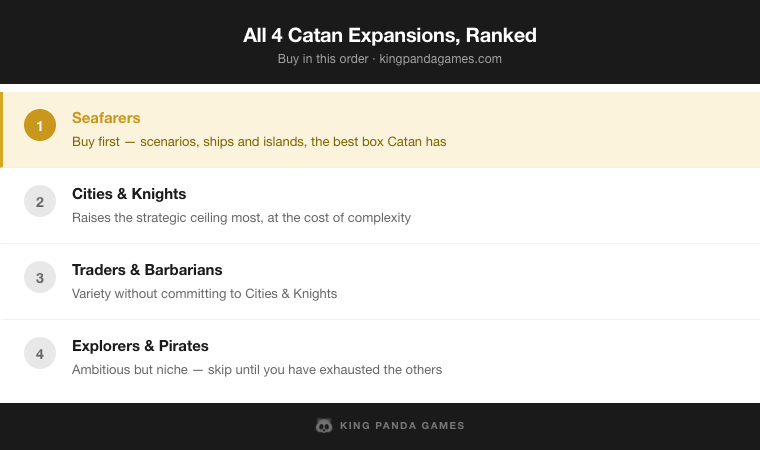
The quick answer: buy Seafarers first. It’s the gentlest expansion to learn, works at every player count, and fixes the “stale endgame” complaint people have about base Catan. Cities & Knights is the best second buy once your group wants more strategic depth. Skip Explorers & Pirates unless you’ve exhausted the others.
The Best Catan Expansion Is Seafarers
The best Catan expansion is Seafarers. It adds boats, islands, and scenario goals without touching a single base rule, so any group that can play Catan can play Seafarers twenty minutes later. Buy Cities & Knights instead if your table has played Catan for years and wants a longer, heavier game with real strategic depth.
Editions vs. Expansions: Know the Difference First
“Should I buy an edition or an expansion?”
These get confused constantly, and the fix is one sentence: an edition replaces your base game; an expansion adds to it. The 25th Anniversary Edition, Star Trek Catan, and other licensed versions are complete standalone copies of the base game with different art or components — you don’t need to already own Catan to buy one, and you wouldn’t own two. An expansion like Seafarers, by contrast, requires the base game and adds new content on top of it. If you already own Catan and want more game, you want an expansion, not an edition.
First: Seafarers ($40–$50)
Buy this one first. It’s the best expansion Catan has.
Seafarers adds a scenario system, boats (which work like roads over water), and multiple islands separated by sea hexes. The basic game becomes an exploration game: players now compete to discover and settle new islands, with bonus victory points for being the first to reach them.
Why it works so well:
It extends the game without breaking it. The base Catan rules work exactly the same. Boats are a natural addition — cheaper in brick but costlier in wool than roads, placed differently. There’s no rule bloat, no new resources, no new mechanics that need a second rulebook. If you can teach someone Catan in 20 minutes, you can teach them Catan + Seafarers in 30.
The scenarios fix the endgame problem. One of the main criticisms of base Catan is that the endgame can feel stale — everyone is settled in, the board is locked, and the last few points come down to dice luck. Seafarers’ scenario structure creates mid- and late-game expansion goals that keep the map alive longer.
It plays better at five or six players. The Seafarers expansion comes with pieces for four players (5–6 play needs both the base and Seafarers 5–6 extensions) (as does the base 5-6 player extension). A larger island system accommodates more players without cramping. If your group regularly plays with five or six, Seafarers is the correct base expansion to start with.
Best scenario to start with: “The New World” — a simple setup that captures the exploration feel without overwhelming new players.
Second: Cities & Knights ($45–$55)
Get this second. It’s more complex but dramatically raises the strategic ceiling.
Cities & Knights is the expansion that converts Catan from a resource-accumulation game into a city-building and defense game. It adds:
- Commodity cards (paper, cloth, coin — produced by cities, separate from the five base resources)
- City improvements (three tracks you can develop using commodities, each granting powerful abilities)
- Knights (placed on the board to repel the barbarian invasion and activate hexes)
- The barbarian ship (which advances each turn and attacks Catan when it arrives — everyone must contribute knights to defend or suffers collective penalties)
The barbarian mechanic is the most important addition. Instead of purely competing, players must also cooperate to defend against the barbarian invasion. The player who contributes the most to the defense when the ship arrives gains the “Defender of Catan” bonus. This creates a compelling tension between competing for resources and cooperating for survival.
Why it’s second, not first: Cities & Knights significantly increases game length (plan for 2–3 hours), adds a meaningful amount of rule complexity, and changes the feel of Catan substantially. First-time expansion players are better served by Seafarers’ gentler addition of mechanics. But once you’re comfortable with Seafarers, Cities & Knights is the best upgrade to the game’s depth.
Note: Cities & Knights and Seafarers can be combined. Playing all three together is a substantial undertaking — budget 3–4 hours and only attempt it with a table of experienced players.
Torn between this and Seafarers specifically? We put them head to head in Cities and Knights vs Seafarers.
Third: Traders & Barbarians ($45–$55)
A solid mid-tier expansion — worth it if you want variety without committing to Cities & Knights’ complexity.
Traders & Barbarians is actually five scenarios and four shorter variants packed into one box, rather than a single cohesive expansion. Highlights:
- The Fishermen of Catan: adds fish tiles and fish tokens that can be traded for powerful benefits — a minor but elegant addition to the resource economy
- The Rivers of Catan: two rivers cross the board and you build bridges over them, earning gold coins that convert into victory points
- Traders & Barbarians (scenario): wagons haul marble, glass, tools and sand across the board to rebuild Catan’s great castle
The fishermen variant in particular is excellent for groups who want a small mechanical tweak without restructuring the game. It fits easily into a regular Catan session and adds genuine decision points without extending play time.
Best for: groups who have played the base game extensively and want fresh scenarios rather than deeper rules.
Fourth: Explorers & Pirates ($50–$60)
Interesting but niche — skip it unless you’ve exhausted the others.
Explorers & Pirates is the most ambitious standalone expansion. Players build ships and explore a completely open ocean map, establishing new home islands, fishing grounds, and spice routes. It’s almost a different game built on Catan’s bones.
The problem: it’s complex in ways that don’t always pay off. The scenario structure requires significant setup time, the rules are dense, and the game can run very long. It’s also harder to teach than any other expansion — the exploratory mechanics require explaining the goal system before players understand why they’re doing anything.
For highly experienced Catan groups who want a substantially different experience, it’s worth the investment. For most groups, Seafarers and Cities & Knights already provide more replay value for less complexity cost.
What to Skip
Catan: Ancient Egypt, Star Trek Catan, Catan Junior — These are licensed versions or simplified variants. Catan Junior is a well-designed children’s introduction to the Catan concept (ages 6–9, about 30 minutes), but it’s a separate product rather than an expansion. The licensed editions play identically to the base game with different art; there’s no strategic reason to buy them unless you specifically want the theme.
Catan Histories: Settlers of America, Rise of the Inkas — These are standalone games using Catan mechanics with a different map and victory conditions. They’re fine but redundant if you already own the base game with expansions. Traders & Barbarians covers similar territory at lower cost.
Recommended Buying Order
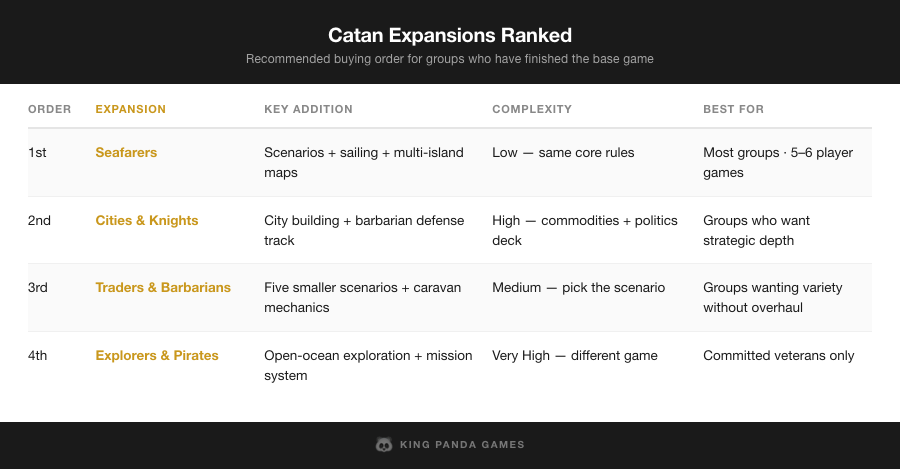
| Order | Expansion | Why |
|---|---|---|
| 1st | Seafarers | Lowest learning curve, highest versatility, adds exploration |
| 2nd | Cities & Knights | Biggest strategic upgrade — get this once Seafarers feels familiar |
| 3rd | Traders & Barbarians | Fresh scenarios without rule overload |
| 4th | Explorers & Pirates | Only for committed, experienced groups |
Every Catan Expansion and Spin-off, Listed
For the full picture — including the products that aren’t really expansions at all:
| Product | Type | Worth it? |
|---|---|---|
| Seafarers | Expansion | Yes — buy first |
| Cities & Knights | Expansion | Yes — buy second |
| Traders & Barbarians | Expansion | Yes — for variety, once you’ve played the first two |
| Explorers & Pirates | Expansion | Only for committed, experienced groups |
| 5-6 Player Extension | Extension (not content) | Required if your group is 5-6 people |
| Catan Junior | Standalone game | Good for kids 6+, not an expansion |
| Star Trek Catan / Ancient Egypt / other licensed sets | Standalone edition | Skip unless you want the theme — same rules as base game |
| Catan Histories: Settlers of America, Rise of the Inkas | Standalone game | Fine but redundant if you own the expansions above |
One final note: expansions require the base game. You need the base Catan box before any of these. If you’re buying for a group that doesn’t own Catan, start there — and check out our review if you’re still deciding whether it’s worth it.
The base game is still the right answer for most groups. But if you’ve played it a dozen times and you’re ready for more, Seafarers is the safest first expansion you’ll ever buy.
What the critics said about Catan
We play these games ourselves, but it’s worth knowing where the rest of the hobby lands.
-
“My rating of Catan is pretty low, actually.”
— Tom Vasel, The Dice Tower. Vasel has played it for decades and still lands cooler on it than its reputation suggests — worth knowing before you treat Catan as an automatic buy.
Going straight to the source: Read the official Catan rules, plus the publisher’s game page and background and history.
📕 Grabbing the rules? Grab this too.
The KPG Budget Board Games Guide — 9 games under $30, each with player counts, play time, and who it’s actually for. Free PDF, no email gymnastics.
Frequently Asked Questions
What is the best Catan expansion?
Seafarers is the best Catan expansion for most groups. It adds exploration, boats, and multiple islands without changing the core rules or significantly increasing game length, which makes it the easiest expansion to teach and the one with the broadest appeal.
How many Catan expansions are there?
There are 4 major gameplay expansions for base Catan — Seafarers, Cities & Knights, Traders & Barbarians, and Explorers & Pirates — plus the 5-6 Player Extension, which isn’t a content expansion but lets more people play. Beyond that, Catan Junior, the licensed editions, and the Catan Histories spin-offs are separate standalone products, not expansions of the base game.
Can you play Catan with all expansions combined?
Technically yes, but it’s not recommended. Combining Seafarers and Cities & Knights already pushes games to 3-4 hours with experienced players; adding Traders & Barbarians or Explorers & Pirates on top creates rule conflicts the official materials don’t fully address. Most groups get more enjoyment picking one or two expansions per session than stacking all of them.
What’s the difference between a Catan expansion and a Catan edition?
An expansion (like Seafarers) adds new content and rules to the base game and requires you to already own base Catan. An edition (like the 25th Anniversary Edition or a licensed theme such as Star Trek Catan) is a complete standalone version of the base game itself, with different components or art but the same core rules. You don’t need both an edition and the base game — an edition replaces it.
What’s the first Catan expansion you should buy?
Seafarers, without much competition. It has the gentlest learning curve of any expansion, works well at every player count including 5-6 with the extension, and fixes base Catan’s most common complaint — a stale endgame — by adding exploration goals.
Do you need the 5-6 Player Extension to play Catan with more people?
Yes. The base Catan box only supports 3-4 players. To play with 5 or 6, you need the separate 5-6 Player Extension, and if you also own Seafarers or Cities & Knights, each of those has its own matching 5-6 player extension you’ll need too.
Which Catan expansion is the best?
Seafarers is the best Catan expansion for most groups. It adds the most new game for the fewest new rules — boats, islands, and scenario goals that slot straight into a normal game of Catan. Cities & Knights is the better pick for experienced tables that want depth over ease, and Traders & Barbarians is the one to grab when you just want fresh scenarios.
Is there a list of all Catan expansions?
Yes. All Catan expansions for the base game are Seafarers, Cities & Knights, Traders & Barbarians, and Explorers & Pirates, plus the 5-6 Player Extension, which adds players rather than content. Catan Junior, the licensed editions like Star Trek Catan, and the Catan Histories games are standalone products, not expansions you add to a copy of Catan.
What is the best expansion for Catan at 5 or 6 players?
Seafarers is the best expansion for Catan at 5 or 6 players. Its larger island setups give six people room to build instead of fighting over the same three hexes. One catch — the base 5-6 Player Extension only covers the base game, so you also need the matching Seafarers 5-6 player extension to run it at that count.