

Catan Review: Is It Worth It?
Catan earns a 4/5 Pandas and 4/5 Bamboo Plants — and after 30 years, that verdict still holds. This is the game that dragged an entire generation away from Monopoly and showed them what modern board gaming could be. It’s not perfect, but it belongs on almost every game shelf. We went back and gave the closet classics an honest re-rating anyway — Clue survives it, Monopoly doesn’t.
Buy it if you want a game that works with almost any group, teaches in under 20 minutes, and generates genuine social chaos. Skip it if your group hates negotiation or gets frustrated when luck plays a role. Try before you buy if you’re not sure your group has the patience for trading — it’s the most divisive mechanic in the game and you need to know going in.
Some links below are Amazon affiliate links — as an Amazon Associate, King Panda Games earns from qualifying purchases at no extra cost to you. Full disclosure.
| Detail | Info |
|---|---|
| Players | 3–4 (6 with the Cities & Knights expansion) |
| Age | 10+ |
| Play time | 60–120 min |
| Bamboo Plants | 4/5 — most groups are playing confidently within one session |
| Pandas | 4/5 — consistently fun, occasionally infuriating in the best way |
| Official site | catan.com |
How Catan Works
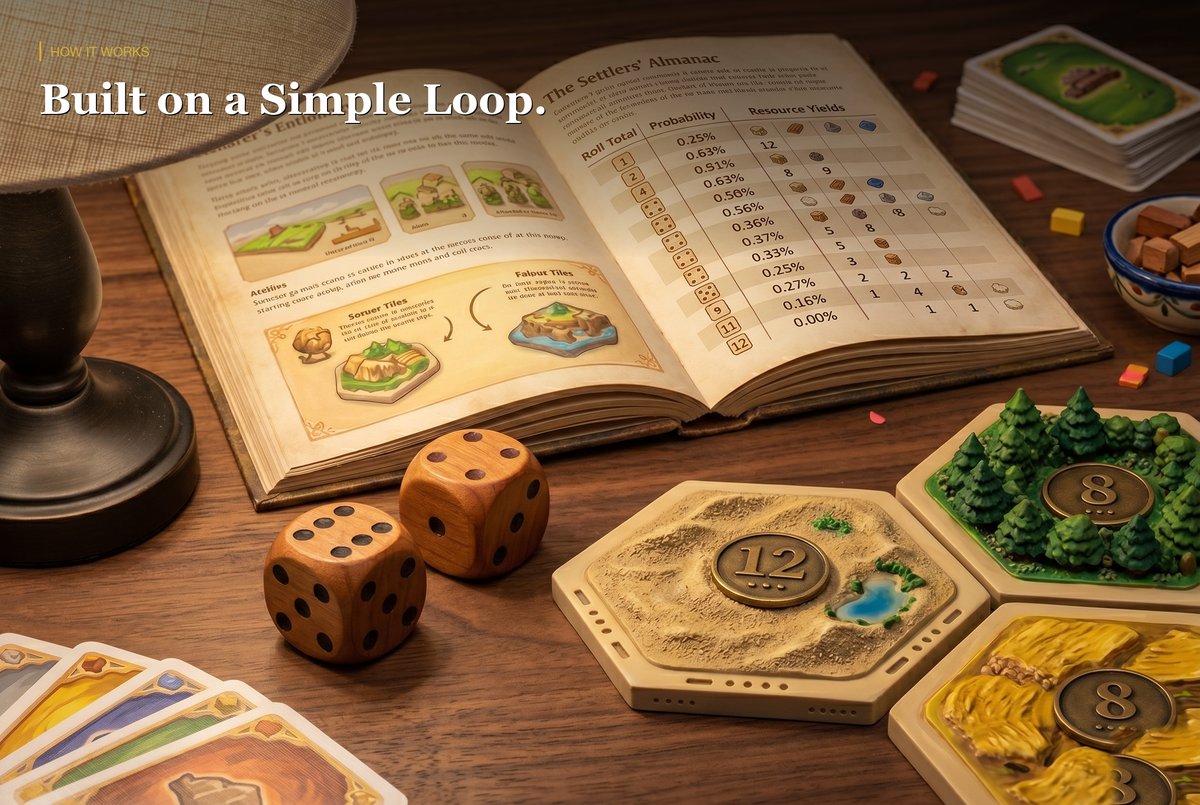
You’re a settler on the island of Catan, competing to build roads, settlements, and cities before anyone else hits 10 victory points. The island is made up of hexagonal resource tiles — forests, fields, mountains, hills, and pastures — each producing one of five resources: wood, wheat, ore, brick, and sheep. Every tile has a number on it. Roll that number on two dice at the start of your turn and everyone with a settlement adjacent to that tile collects the matching resource. It lands at #13 on our best board games of 2026 list.
That’s the engine. Everything else is built on top of it.
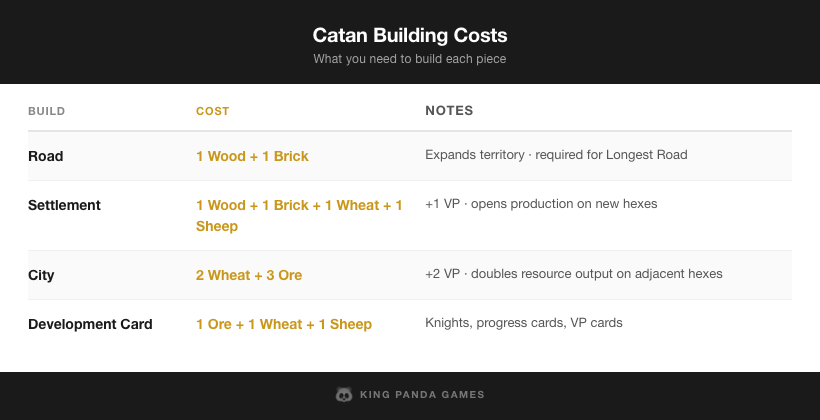
Resources get spent on building. Roads cost wood and brick. Settlements cost wood, wheat, brick, and sheep. Cities — which double your resource production — cost ore and wheat. Development cards, which grant special abilities and hidden victory points, cost ore, wheat, and sheep. Managing which resources you’re producing and which you’re short on is the core strategic puzzle of every game.
The catch is that no one player can produce everything efficiently. The island’s layout guarantees it — the best spots for ore are often far from the best spots for wood. This is where trading comes in. You can trade resources freely with other players on your turn, and four matching resources can always be traded to the bank at a 4:1 rate (better with a port). The negotiation table is where Catan earns its reputation.
The robber adds teeth. When a 7 is rolled — and it gets rolled constantly — whoever rolled it moves the robber token to any hex, blocking resource production on that tile until someone else moves it. They also steal a random resource from a player whose settlement borders the new hex. The first time the robber lands on your best tile right before you can spend those resources, you understand exactly what this game is about.
First player to 10 victory points wins. Points come from settlements (1 each), cities (2 each), the Longest Road card (2 points), the Largest Army card (2 points), and victory point development cards.
A typical game runs 60 to 90 minutes with experienced players. With new players, give it two hours. It moves fast once everyone knows what they’re doing.
What We Liked
The trading table is genuinely social. No other game in this category creates the same negotiation energy. You need wheat and someone has wheat but won’t trade it unless you give them ore, but someone else wants your ore, so now there’s a three-way negotiation happening that has nothing to do with the rules and everything to do with personalities. We’ve had whole friendships tested over a bad sheep trade. That’s not a bug — it’s the feature.
It teaches in one playthrough. The 4/5 Bamboo Plants rating is earned. The rules have enough nuance that experienced players play meaningfully differently than beginners, but the core loop — roll dice, collect resources, spend resources on buildings — clicks within the first few turns. We’ve taught Catan to complete board game newcomers and had them playing independently by turn five. Very few games at this complexity level achieve that.
Every game starts differently. The board is modular — the hex tiles and number tokens are placed randomly each setup, so no two games start from the same position. A starting position that was dominant last game might be weak this game if the ore and wheat hexes ended up poorly numbered. This variability keeps the game fresh in a way that fixed-board games can’t replicate.
The moment the robber hits your best spot. We know we listed this as a feature and we mean it. The first time someone rolls a 7, moves the robber directly onto your 6-ore hex, and takes your last resource card, the table reacts. There’s shouting, there’s laughter, there’s immediate retaliation planning. That moment — and its many variations — is the social heartbeat of Catan. No other mechanic in the game generates the same table energy.
It scales across experience levels. Experienced Catan players and beginners can sit at the same table and both have a real game. The beginner might lose, but they understand why they lost and they want to play again. That accessibility without sacrificing depth is genuinely rare.
What We Disliked
Luck can override good play. If the dice refuse to roll your numbers for four consecutive turns while your opponent’s numbers hit constantly, there’s nothing strategic you can do. This doesn’t happen every game, but it happens enough that some sessions end with a player feeling cheated rather than outplayed. The randomness is baked into the core — it’s not a flaw, it’s a design choice — but it’s worth knowing before you invest in the game.
Three players is noticeably weaker than four. With three players, the board has unfilled hexes, the trading economy is thinner, and the blocking dynamics shift. The game still works, but the social chaos that makes Catan special needs four players to fully ignite. If you regularly play with groups of three, consider the Cities & Knights expansion or Catan: Explorers & Pirates, which both play better at lower counts.
It can run long with analysis-prone players. Most groups finish in 90 minutes. Some groups — you know who you are — spend three minutes on every single trade negotiation, debate every possible road placement, and somehow turn a 90-minute game into three hours. The game doesn’t punish this, but it will test the patience of everyone else at the table.
Who Catan Is For
Catan is the best gateway game for groups that are ready to step past simple card games but aren’t ready for something with a 30-page rulebook. It’s genuinely ideal for:
Friend groups that enjoy social games. The negotiation and robber dynamics create genuine interpersonal moments. If your group loves laughing at each other’s misfortune while plotting revenge, Catan is built for you.
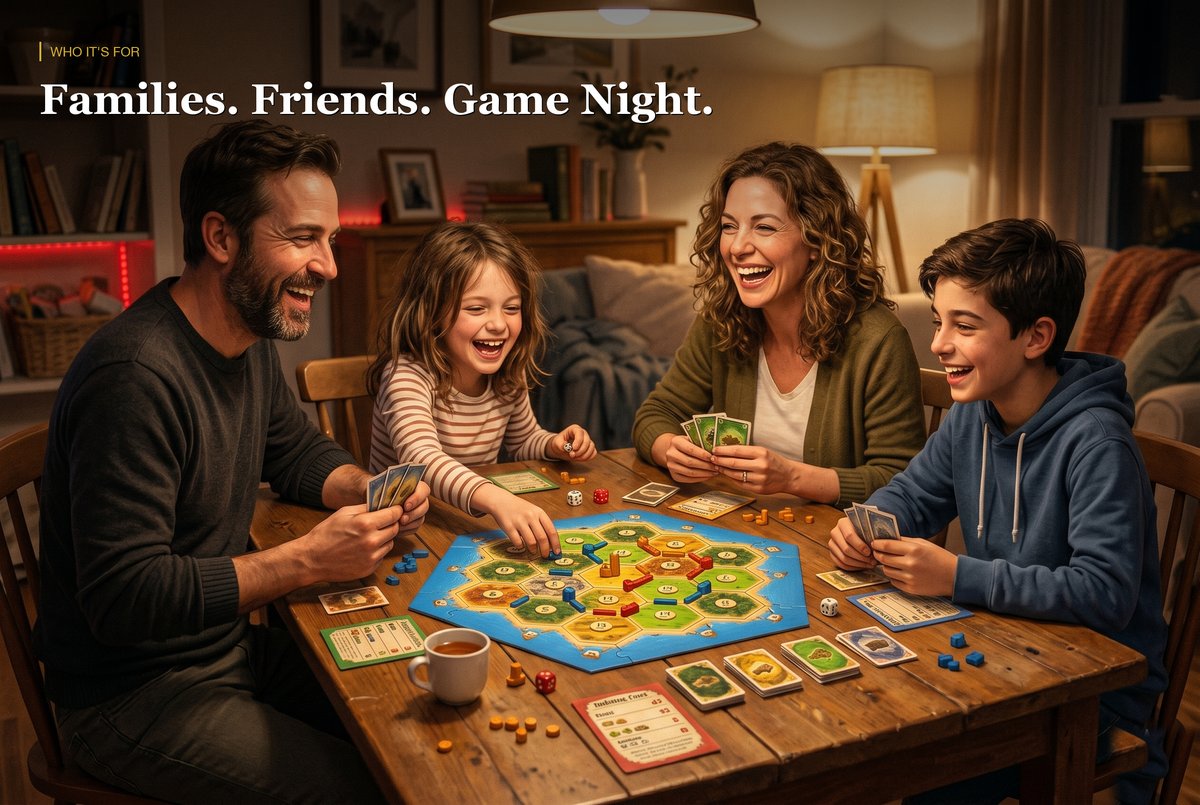
Families with kids 10 and up. The trading mechanic teaches real negotiation skills. Kids pick it up quickly and often out-negotiate the adults because they’re less attached to their resources. We’ve watched 11-year-olds absolutely destroy grown adults at Catan by being more willing to take risks on trades.
Board game newcomers. If someone in your life has never played a modern board game and you want to start somewhere, Catan is one of the three games we’d recommend first. It’s accessible, engaging, and builds a genuine appetite for more.
It’s not ideal for groups that get frustrated with randomness, players who dislike negotiation or find trading stressful, or anyone looking for a pure strategy experience where skill is the only determinant. Those groups should look at something like Ticket to Ride for accessibility or Wingspan if they want more strategic depth.
Awards
Catan won the Spiel des Jahres — the most prestigious award in board gaming — in 1995. It’s been inducted into multiple game halls of fame and is consistently cited as one of the most important board games ever designed. Klaus Teuber, the game’s designer, transformed the hobby with this single release. An estimated 50 million copies have been sold worldwide, making it one of the bestselling board games of all time.
How Catan Compares
Ticket to Ride is the closest peer in terms of audience and accessibility. Both are gateway games that work with newcomers. Ticket to Ride is significantly lighter on conflict — there’s no robber, no negotiation, and the only interaction is blocking routes. It’s a better choice for groups that dislike direct conflict. Catan is better for groups that enjoy social chaos and negotiation. [link: once published, link to /ticket-to-ride-review/]
Wingspan is where many Catan players go next. It’s more complex, more engine-driven, and less confrontational — there’s no negotiation and the conflict is passive (taking resources or bird spaces others wanted). If someone plays Catan a dozen times and wants something with more strategic depth and less luck variance, Wingspan is our recommendation. [link: once published, link to /wingspan-review/]
Pandemic is the cooperative alternative. No competition, no trading, everyone working together. If your group’s Catan games devolve into bitter negotiations, Pandemic gives you the same accessibility and social engagement without the conflict. [link: once published, link to /pandemic-review/]
Tips & Tricks
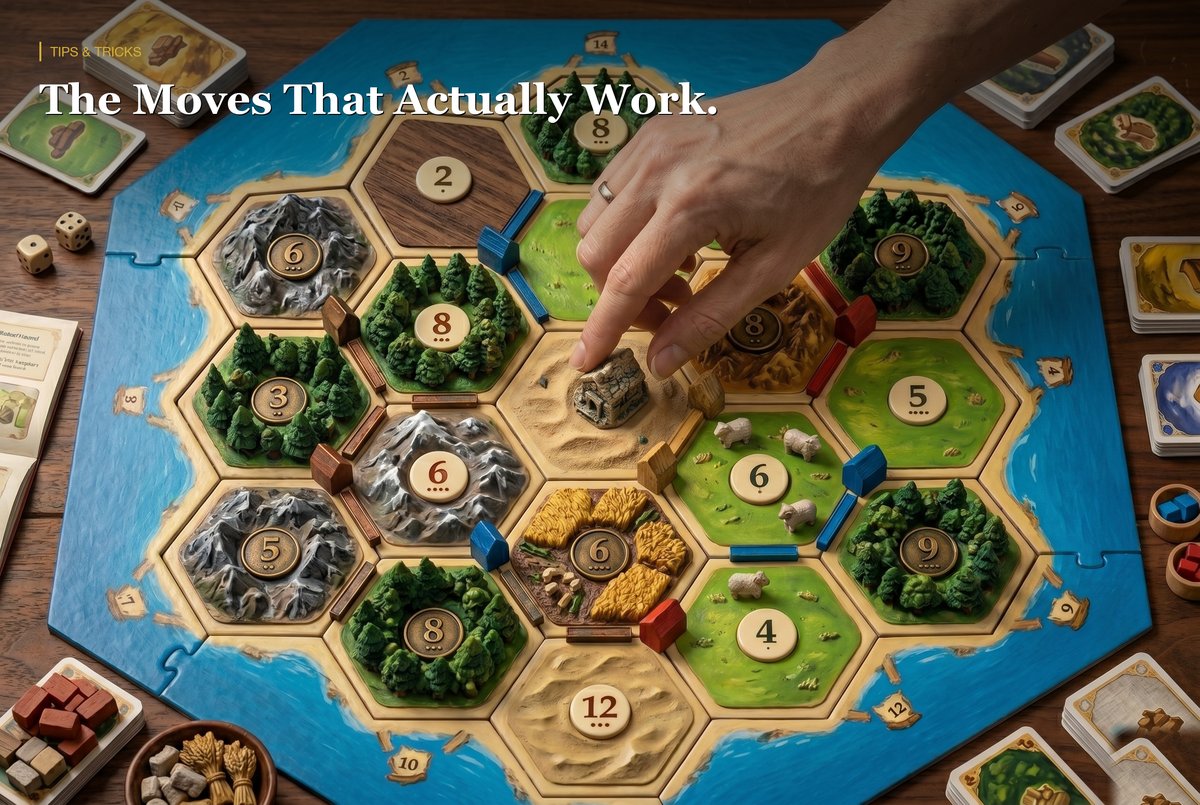
Diversify your numbers, not just your resources. New players chase resources — “I need ore so I’ll build near ore.” Experienced players chase numbers. A settlement touching three different resources on 5, 6, and 8 will produce more total resources than a settlement on the three best ore hexes if those ore hexes have 3, 4, and 11 on them. High-probability numbers (6 and 8 first, then 5 and 9) matter more than resource diversity.
Build your first road toward the best second spot, not toward your opponent. In the opening, almost everyone makes the mistake of building their initial road toward an opponent to block them. Instead, identify the best second settlement location on the board before you place your first settlement, then build your road straight toward it. You want your second settlement placed by turn 4 or 5. Every turn it’s delayed is resource production you’re not getting.
Trade aggressively in the first half, conservatively in the second. In the early game, almost any trade that gets you closer to a settlement is worth taking. In the late game — once you’re past 6 points — every resource you trade away potentially delays your win. Late-game Catan is about hoarding resources for the final push, not trading them.
The Largest Army card is almost always worth pursuing. Three knights played (three development cards drawn and activated) gets you the Largest Army card and its 2 victory points. It’s one of the most reliable paths to points in the game because your opponents usually undervalue development cards in favor of building. Buy one development card per turn whenever you have the resources for it.
Use the robber as a diplomatic tool, not just an attack. Beginners always move the robber onto whoever’s winning. Experienced players use the robber to make deals — moving it off a player’s tile in exchange for a favorable trade, or threatening a move unless someone offers resources. The robber is leverage. Treat it like one.
Want to Go Deeper?
- How to Win at Catan: Strategy Guide for Beginners — The five principles that separate players who always lose from players who win consistently. Read it here
- Catan vs Carcassonne: Which Should You Learn First? — If you’re choosing between these two gateway classics, here’s our honest comparison. Read it here
- Catan Robber Strategy: Where to Place It and When to Move It — The robber is the most powerful mechanic in the game. Here’s how to actually use it. Read it here
- Catan Best Starting Placement: Where to Settle First — Your first two settlements determine 80% of your game. Here’s how to place them. Read it here
- Catan Expansions Ranked: Which One Should You Buy First? — There are a dozen Catan expansions. Here’s which ones are actually worth it. Read it here
Verdict
Buy it. Catan has been the best gateway board game for 30 years for a reason. It’s not the deepest game, it’s not the fairest game, and it won’t satisfy players who want pure strategy. But it’s the most social, most accessible, most reliably fun game in its category, and it belongs in almost every collection.
If you already own it and haven’t played in a few years — pull it back out. It holds up.
Skip it only if your group actively dislikes negotiation or is highly sensitive to luck variance. There are better games for those groups.
Try before you buy if you’ve never negotiated in a board game before. The trading is the soul of Catan and you need to know you enjoy it.
Catan official site: catan.com
And if your group would rather team up than trade against each other, cooperative games scratch a completely different itch — our Spirit Island review covers the genre’s deep end.
Not sure whether Catan is the right step for your group? It is number 3 of 12 on our strategy board games list, ranked easiest to hardest to learn.
Frequently Asked Questions
Is Catan worth buying in 2026?
Absolutely, yes! King Panda Games gives Catan a strong 4/5 Pandas, affirming its enduring appeal even after 30 years. It's a fantastic gateway game that still belongs on almost every game shelf, perfect for introducing new players to modern board gaming.
How long does a game of Catan typically last?
A typical game of Catan for 3-4 players usually runs between 60 to 120 minutes. While the rules are simple to learn, the strategic depth and player interaction can extend playtime, especially with new groups.
What is the main goal in Catan?
The main goal in Catan is to be the first player to reach 10 victory points by strategically expanding your settlements and cities across the island. You achieve this by collecting and trading resources to build roads, settlements, and cities, and by acquiring development cards.
Is Catan a good game for beginners?
Catan is an excellent choice for beginners, earning 4/5 Bamboo Plants for its ease of learning. It teaches in under 20 minutes and provides a clear path into modern board gaming, making it ideal for almost any group looking for an engaging experience.
What makes Catan's trading mechanic so important (and divisive)?
Catan's trading mechanic is crucial because no single player can efficiently produce all five necessary resources, forcing negotiation with opponents. This social chaos is a core part of the fun for many, but it can be divisive for groups who dislike direct player interaction or get frustrated by the luck of the dice influencing trade leverage.
Does Catan rely too much on luck?
While dice rolls certainly introduce an element of luck in Catan, it's a misconception that the game is *only* about luck. Strategic placement of settlements, clever resource management, and skillful negotiation are far more critical to consistent success. Don't let the dice fool you; Catan rewards smart play over pure chance.
How many players can play Catan?
The base game of Catan is designed for 3-4 players, offering the most balanced and engaging experience. However, if you want to include more friends, the popular Cities & Knights expansion allows up to 6 players to join the fun.