

Carcassonne Meeple Placement: When to Commit and When to Hold Back
Seven meeples. That’s all you get.
In a game that runs 70 to 90 tiles, you’re making meeple decisions on roughly half of those turns. The other half you’re placing tiles with no meeple at all — which is often the correct play. Understanding when to commit a meeple and when to hold back is the most nuanced skill in Carcassonne, and it’s what separates players who feel like they’re always running dry from players who seem to always have a piece available when it matters.
If you want a broader look at Carcassonne strategy, see our full Carcassonne review.
Some links below are Amazon affiliate links — as an Amazon Associate, King Panda Games earns from qualifying purchases at no extra cost to you. Full disclosure.
The Problem With Placing Every Turn
When you place a meeple every turn, your supply drains quickly. By mid-game you’re at two or three pieces. Features haven’t completed, so your pieces aren’t coming back. Then a high-value city closes up and you can’t claim it. Or someone plays a tile that creates the perfect farmer entry point and you have nothing to place.
The opportunity cost of over-placing is invisible in the early turns and brutal in the mid-game. The meeple you spent on a 2-point road in turn four is the meeple you needed for a 12-point city completion in turn fourteen.
The guiding principle: every meeple placement is an investment. Before placing, ask — what is the expected return on this piece, and is this the best use of my supply right now?
The Value Hierarchy
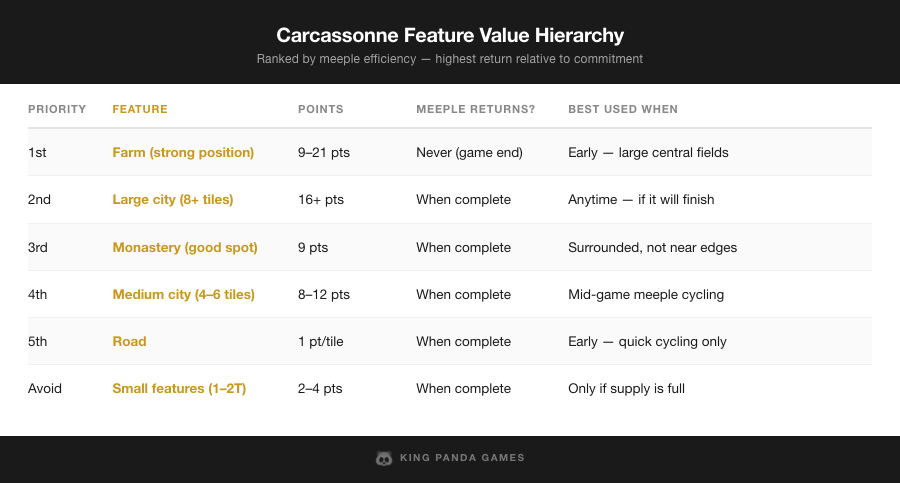
Not all features are equal. Here’s a rough ordering of meeple value, from highest to lowest:
Farms (highest long-term value). A farmer in a strong position can return 9–21 points at game end. The catch: the meeple never comes back until the final tally. Farms are long-term commitments with asymmetric upside. Place farmers early, in large central fields that border multiple cities under construction.
Large cities. A city with 8+ tiles, completed, scores 16+ points. The meeple returns when the city closes, freeing it for reuse. Large cities are the best combination of high return and eventual meeple recovery — as long as they actually complete. Watch for cities that are getting too extended to finish.
Monasteries in good positions. A monastery surrounded by 8 other tiles scores 9 points — one of the most efficient point sources per meeple in the game. The challenge: monasteries in the middle of the board fill in quickly; monasteries near the edges may never complete. Only claim a monastery if the surrounding area has room to develop and isn’t going to dead-end.
Small-to-medium cities (4–6 tiles). Completable quickly, return the meeple relatively fast, score reasonably well. These are the bread-and-butter placements — not spectacular, but reliably efficient.
Roads. Short roads score 1 point per tile and complete quickly, returning your meeple fast. Long roads score more but tie up a meeple for a long time. Roads are useful early when you need quick meeple cycling, but they’re rarely the highest-value play.
Small features (1–2 tile cities, very short roads). Avoid unless you have a full meeple supply and nothing better to claim. The return is too low for the investment.
When to Hold Back
Hold back when:
The feature has low completion probability. A city with a difficult-to-connect shape, extending to the edge of the board, or requiring specific tiles to close — these are meeple traps. You’ll tie up a piece for 20 turns and potentially score half points at game end. Pass.
You’re already at three or fewer meeples. Running below four means a bad stretch of turns can empty your supply entirely. If you’re low, be disciplined about what you claim. Only place meeples on high-value, short-payoff features that will return pieces quickly.
The feature benefits your opponent more than you. Sometimes the best tile placement is tactical — blocking an opponent’s expansion, connecting a road in a way that slows their city, completing a feature that was trapping your meeple. These are no-meeple turns by design.
You have a farmer down and need to defend. When you’re in farm defense mode (actively placing tiles to close your field’s border), you often can’t afford to place additional meeples. Prioritize protecting the farm over claiming new features.
When to Commit
Commit when:
A high-value position opens up that won’t last. The best intersection on the board for a farmer, or a large city with an easy completion path — these windows close fast in a competitive game. If you have the meeple and the position is genuinely strong, place it.
You can join a feature and force a tie or take majority. This is often the best use of a meeple in the mid-game. If an opponent has built a 10-tile city and you can connect your meeple to it and force shared scoring, that single placement could earn you 20+ points off their labor — and if you own Inns & Cathedrals, the large meeple counts as two in that fight, which usually settles the majority outright.
A monastery is surrounded or nearly surrounded. If seven or eight tiles are already placed around a monastery position, claiming it and completing it in the next two or three turns is one of the fastest meeple returns in the game.
You’re approaching the end of the tile stack. In the final 15–20 tiles, you want your meeples working. Completing mid-sized features for guaranteed points is better than holding supply for a high-value play that may not come.
Reading Your Supply Mid-Game
Get in the habit of counting your meeples in hand at the start of each turn — not just when you’re deciding whether to place, but as a running awareness. Four or more in hand: you have flexibility. Three: be selective. Two: only place on high-certainty, fast-return features. One: play defensively until a piece comes home.
Also watch your opponents’ supply. An opponent running low can’t respond to an aggressive join. An opponent with a full hand can contest anything.
The meeple is not a resource you spend — it’s a resource you invest and recover. The best Carcassonne players maintain supply discipline throughout the game, cycling pieces through efficient features and always keeping enough in reserve to respond to what the tile draw presents.
Check Carcassonne: Inns & Cathedrals price on Amazon →
Frequently Asked Questions
Why shouldn't I place a meeple on every turn in Carcassonne?
Placing a meeple every turn quickly depletes your limited supply of seven pieces, leaving you without options for high-value features later in the game. This often leads to missing out on crucial scoring opportunities like large cities or prime farming positions. It's an invisible opportunity cost that becomes brutal in the mid-game.
What's the most important skill for Carcassonne meeple placement?
The most crucial skill is understanding when to commit a meeple and when to hold back. This nuanced decision-making separates players who consistently run out of pieces from those who always have a meeple available for critical plays, maximizing their scoring potential. Every placement should be viewed as an investment with an expected return.
When should I prioritize placing a farmer in Carcassonne?
Farmers offer the highest long-term value, often scoring 9-21 points at game end, so place them early in large, central fields that border multiple cities under construction. Remember, this meeple is a permanent commitment and won't return until final scoring, so choose its location wisely for maximum impact.
Are all features equally valuable for meeple placement in Carcassonne?
Absolutely not; this is a common misconception! The article clearly outlines a value hierarchy, with farms offering the highest long-term points and large cities providing the best combination of high return and meeple reusability. Don't waste your precious meeples on low-value roads or small cloisters when bigger opportunities exist.
How many meeples do you get in Carcassonne?
You are limited to exactly seven meeples throughout the entire game of Carcassonne. With 70 to 90 tiles typically played, this scarcity means you'll be making meeple decisions on roughly half your turns, emphasizing the importance of strategic placement and conservation.
What's the best strategy for using meeples on large cities in Carcassonne?
Large cities are excellent targets for meeple placement because they offer high returns (16+ points for 8+ tiles) and, crucially, return your meeple upon completion. Prioritize claiming these features to score big points and free up your meeple for subsequent high-value plays.
What question should I ask myself before placing a meeple?
Before committing a meeple, always ask: 'What is the expected return on this piece, and is this the best use of my supply right now?' This guiding principle ensures every placement is an intentional investment, preventing you from squandering meeples on low-value features when bigger opportunities are on the horizon.