

6 Nimmt! Strategy: How to Take Fewer Bullheads
Your low cards are the most dangerous thing in your hand. That single idea, understood properly, is most of what separates people who win at 6 Nimmt! from people who think it’s a luck game. You can’t control where your card goes — the rules decide that — so all your skill lives in which card you release and when.
Some links below are Amazon affiliate links — as an Amazon Associate, King Panda Games earns from qualifying purchases at no extra cost to you. Full disclosure.
Dump Low Cards Early, Always
A card too low to fit any row forces you to take a full row. That’s the harshest outcome in the game, and it gets worse as a round progresses, because rows grow from one card to five.
Play your 4 on turn one and you’ll probably take a row of one or two cheap cards. Hold that same 4 until turn nine and you’ll be taking five cards, several of which are likely doubles or multiples of ten.
The rule: if you’re holding a card below 15 after turn three, you’ve already made a mistake. Spend them while the rows are short and the penalty is small.
Memorize the Bullhead Math
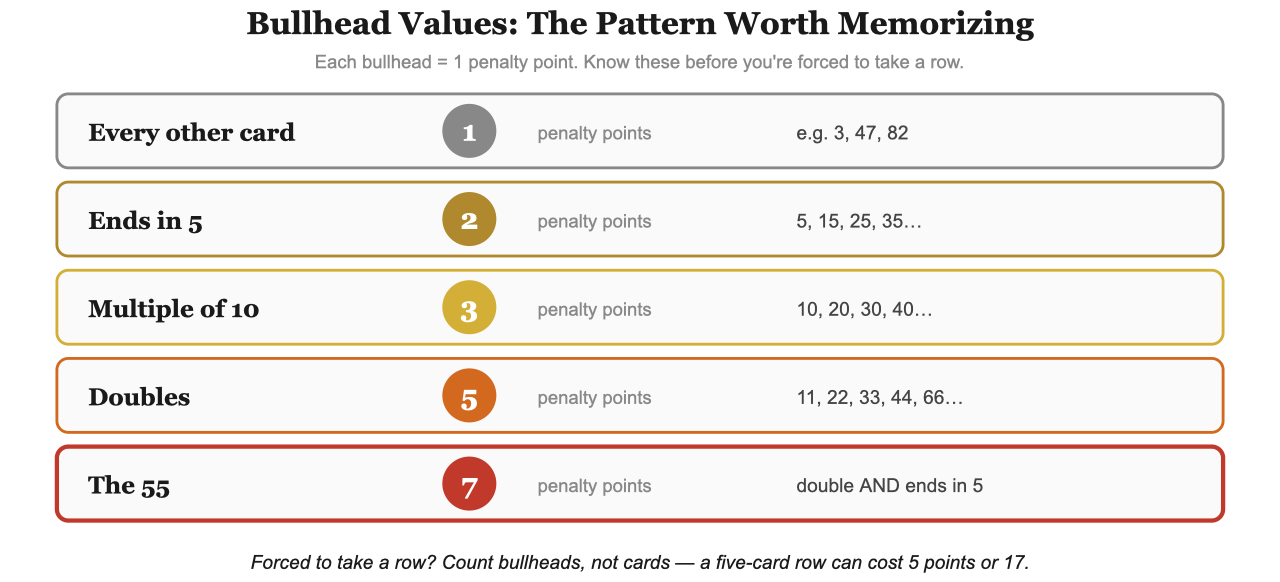
Bullheads aren’t random, and knowing the pattern turns a forced row-take from a guess into a calculation:
- Every card is worth at least 1.
- Cards ending in 5 (5, 15, 25…) are worth 2.
- Multiples of 10 (10, 20, 30…) are worth 3.
- Doubles (11, 22, 33, 44, 66…) are worth 5.
- The 55 is both a double and ends in five — 7 bullheads, the worst card in the deck.
When you’re forced to choose a row, this is the whole decision. A five-card row of ordinary numbers costs 5 points; a five-card row containing 55, 40, and 33 costs 17. Count before you grab.
Take a Row on Purpose
When should you deliberately eat a row?
When it’s cheap and you’re the one choosing. If a row holds four low-value cards totaling 4 bullheads, and you’re holding a card that will clearly be the lowest played this turn, taking that row voluntarily is often the best move on the board. You reset a dangerous row, you pay almost nothing, and you avoid being forced into a 15-point row three turns later.
Turn six. The second row holds 21, 23, 26, 29 — four cards, five bullheads total. You’re holding a 6, which fits nowhere. Everyone else is clearly playing high; the rows ending in 88 and 94 are filling fast. Take the second row now for 5 points, put your 6 down as the new row starter, and you’ve dodged the 88-row disaster that’s coming for somebody in two turns.
The mistake isn’t taking a row. The mistake is taking the row the game picks for you.
Play Just Below the Crowd
Cards resolve in ascending order, which creates a defensive trick most players never notice: a card that lands just below where everyone else is playing gets to slot in before their cards pile onto the same row.
What most players do: look at the row’s last number and pick a card that fits comfortably above it, feeling safe because there’s room.
What actually works: think about how many other people are also targeting that gap. A row ending in 60 with two cards looks safe — until four players all play into the 60s and the last one takes it. Being the lowest card in a popular range is far safer than being the highest.
This is why 6 Nimmt! rewards reading people rather than reading the board. The board tells you what’s legal; the players decide what’s fatal. If you would rather read one opponent at a time, No Thanks! is the sequential version of that idea.
Late in the Round, Count What’s Gone
With 104 cards and ten in your hand, whole ranges get exhausted as a round plays out. By turn eight, if nobody’s played anything in the 70s and you hold the 76, the odds that someone dumps a 77–79 on top of you are much lower than they were on turn two.
You don’t need perfect tracking. Just noticing “nothing in the 30s has hit the table all round” is enough to make a 34 look far more attractive than it did earlier.
That’s the whole arc of a well-played round: dangerous low cards first, calculated risks in the middle, and confident plays at the end when the deck’s shape is visible. The official Amigo rulebook is free if you want to check an edge case, and BGG’s 6 Nimmt! forums are where the deeper probability arguments live. If you’re still deciding whether the game deserves the shelf space, our full 6 Nimmt! review makes the case — and it’s the game we rank first on our best BBQ card games list for good reason.
Don’t own 6 Nimmt! yet? This guide assumes the base game.
Check 6 Nimmt! price on Amazon →
Frequently Asked Questions
What is the best strategy in 6 Nimmt!?
Dump your low cards early while rows are still short, memorize the bullhead values so forced row-takes are calculated rather than random, and take cheap rows on purpose instead of waiting to be forced into expensive ones.
Why are low cards bad in 6 Nimmt!?
A card too low to fit any row forces you to take an entire row of your choice. Because cards resolve in ascending order, low cards resolve when rows are at their fullest from the previous turn — so a low card held late costs far more than the same card played early.
When should you take a row on purpose in 6 Nimmt!?
When the row is cheap and you’re choosing it rather than being forced into it. Voluntarily taking a four-card row worth 4 or 5 bullheads is often better than risking a five-card row containing a 55 or several doubles later in the round.
Which cards are worth the most bullheads in 6 Nimmt!?
The 55 is worst at seven bullheads, since it’s both a double and ends in five. Other doubles like 22 and 77 are worth five, multiples of ten are worth three, cards ending in five are worth two, and everything else is worth one.
Is 6 Nimmt! a game of skill or luck?
Both, and skill wins over a full game to 66 points. Individual rounds can be decided by a bad deal, but players who manage their low cards and count the table consistently finish with fewer bullheads across a session.
How do you avoid taking the sixth card in a row?
Track how many cards each row holds, not just the number it ends on. A row ending in 40 with two cards is safe; the same row with five cards is a trap, and new players consistently read only the number.
Do this in your next game: fan your hand, find every card under 15, and plan to play all of them in the first four turns. It’s the fastest improvement available.