

6 Nimmt! Player Count: Best at 6, Ranked From 2 to 10
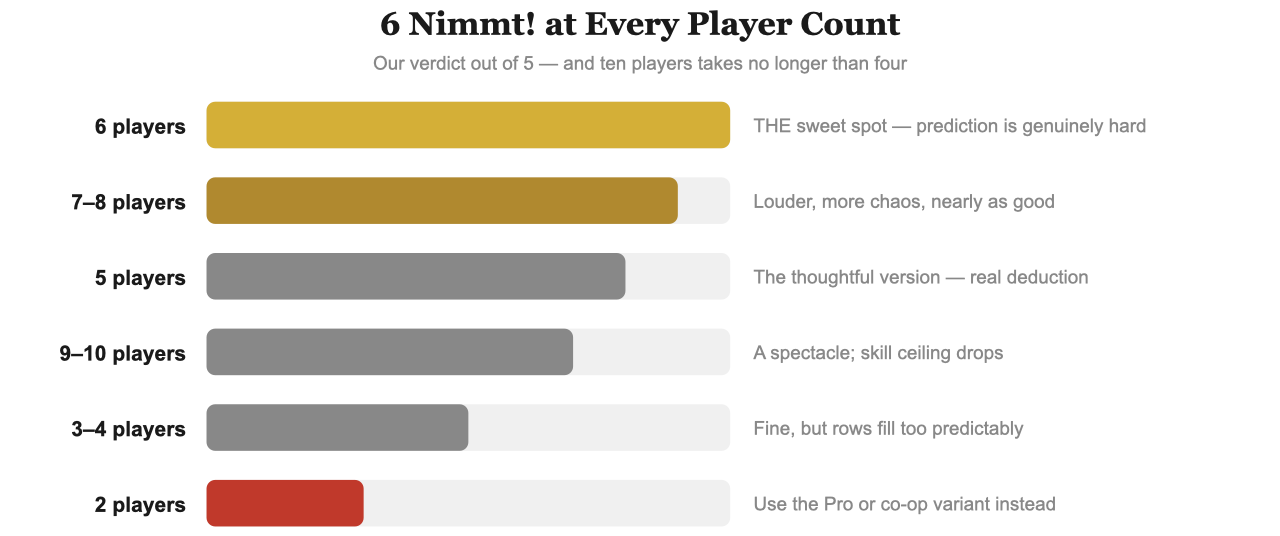
6 Nimmt! is best with 6 players, and it’s the rare game that gets better as you add people rather than slower. The box says 2–10, and the honest ranking runs 6, then 7–8, then 5, then 9–10, then 4, then 3, then 2. Here’s what actually changes at each count — and why the game’s headline feature is that ten players takes no longer than four.
Some links below are Amazon affiliate links — as an Amazon Associate, King Panda Games earns from qualifying purchases at no extra cost to you. Full disclosure.
Why Adding Players Costs No Time
Everyone chooses their card simultaneously. There’s no turn order to wait through — all ten players commit at once, then cards resolve by number in a few seconds. If that resolution order is new to you, our 6 Nimmt! rules walkthrough spells out exactly where each card lands.
This is the single most valuable property 6 Nimmt! has. A ten-player game of almost anything else means waiting nine turns between decisions; here it means nine more people whose intentions you can’t predict, resolved in the same thirty seconds. It’s why the game opens our best card games for a BBQ roundup.
6 Players: The Sweet Spot
Six is where prediction gets genuinely hard without going fully random. Rows fill fast enough that every card carries real risk, but you can still roughly track what’s been played and reason about the ranges people are holding.
Below six, the math is tractable enough that a careful player can mostly steer clear of trouble. Above eight, so many cards hit the table each turn that planning gives way to hoping. Six sits exactly between those, which is where a game about reading people wants to be.
7–8 Players: Louder, Nearly as Good
Seven and eight bring more chaos and more table noise, and the game holds up beautifully. You’ll take more rows and lose more predictably to circumstance — but with a crowd that’s usually the point.
The one cost: with eight players, up to eight cards land per turn across four rows, so rows flip over fast. Careful play matters less, and the person who wins is more often the person who dodged well than the person who planned well.
5 Players: The Thoughtful Version
Five gives you enough uncertainty to make decisions interesting while leaving room for actual deduction. Late in a round you can often work out what ranges are exhausted and play accordingly.
Is five better than six? For groups who like their fillers a bit more strategic, honestly yes. We rank six higher because 6 Nimmt!’s best moments are social explosions, not clean plays — but five is the count for a table that wants to think.
9–10 Players: A Spectacle
Ten players is a party trick, and a good one. Almost nothing else handles ten without becoming a slog, and this handles it in 45 minutes.
What people expect at 10 players: a long, chaotic mess where nobody can do anything meaningful.
What actually happens: a fast, chaotic mess where nobody can do anything meaningful — and everyone has a great time anyway. The skill ceiling drops through the floor, which is exactly right for the kind of party where you’re playing with ten people.
3–4 Players: Fine, Not Special
At three or four, only three or four cards hit the table per turn, so rows creep toward five slowly and you can often see trouble coming a full turn ahead. Games get quieter and a bit longer in feel, since it takes more turns for the pressure to build. At that size a tighter filler is often the better call — No Thanks! peaks at four or five players.
Nothing’s broken here. It’s just that half the reason to own this game is its crowd capacity, and at four you could be playing something with more depth.
2 Players: The Weakest Count
Two-player 6 Nimmt! is a shadow of the real game. With only two cards landing per turn, rows fill predictably, and the central pleasure — having no idea what six other people are about to do — simply isn’t there.
The box acknowledges this with a Pro Variant for 2–6 players, which adds tactical structure specifically for smaller counts. There’s also the cooperative “Beat the Buffalo” mode for 1–6 players in the 30th anniversary edition — both are documented in the official Amigo rulebook, where you team up against a bot — genuinely the best way to play with one other person.
For couples looking for a regular two-player game, our best 2-player games list has better options.
Don’t own 6 Nimmt! yet? This guide assumes the base game.
Check 6 Nimmt! price on Amazon →
Frequently Asked Questions
What is the best player count for 6 Nimmt!?
Six. That’s where predicting the table becomes genuinely difficult without turning random — rows fill fast enough to make every card risky, but you can still track roughly what’s been played. It’s excellent from 5 to 8.
How many players can play 6 Nimmt!?
Two to ten with the base deck of 104 cards, no expansions needed. The 30th anniversary edition adds a cooperative variant that supports 1 to 6 players.
Does 6 Nimmt! take longer with more players?
Barely. Everyone chooses their card simultaneously, so a ten-player game runs about as long as a four-player one — roughly 30–45 minutes. This is the game’s single best feature for large groups.
Is 6 Nimmt! good with 2 players?
It’s the weakest count. With only two cards hitting the table per turn, rows fill predictably and the guessing that drives the game disappears. Use the Pro Variant or the cooperative Beat the Buffalo mode instead.
Can you play 6 Nimmt! with 10 people?
Yes, and it’s one of very few games that handles ten well. The skill element thins out considerably at that count, but it stays fast and it stays fun — ideal for parties rather than game nights.
What’s the best player count for strategic 6 Nimmt!?
Five. There’s enough uncertainty to keep decisions live, but few enough cards per turn that you can deduce which ranges are exhausted and play around them.
Whatever your headcount, the game underneath is the same $12 deck we rated 4/5 Pandas in our full 6 Nimmt! review — just know that “2–10 players” on the box and “best at six” are two very different claims.